





Investment monitoring reports are a crucial legal obligation for investors to maintain project compliance. Understanding the regulations regarding documentation, deadlines, and submission methods not only helps businesses avoid unnecessary administrative penalties but also facilitates smoother project adjustments in the future.
What is an investment monitoring report?
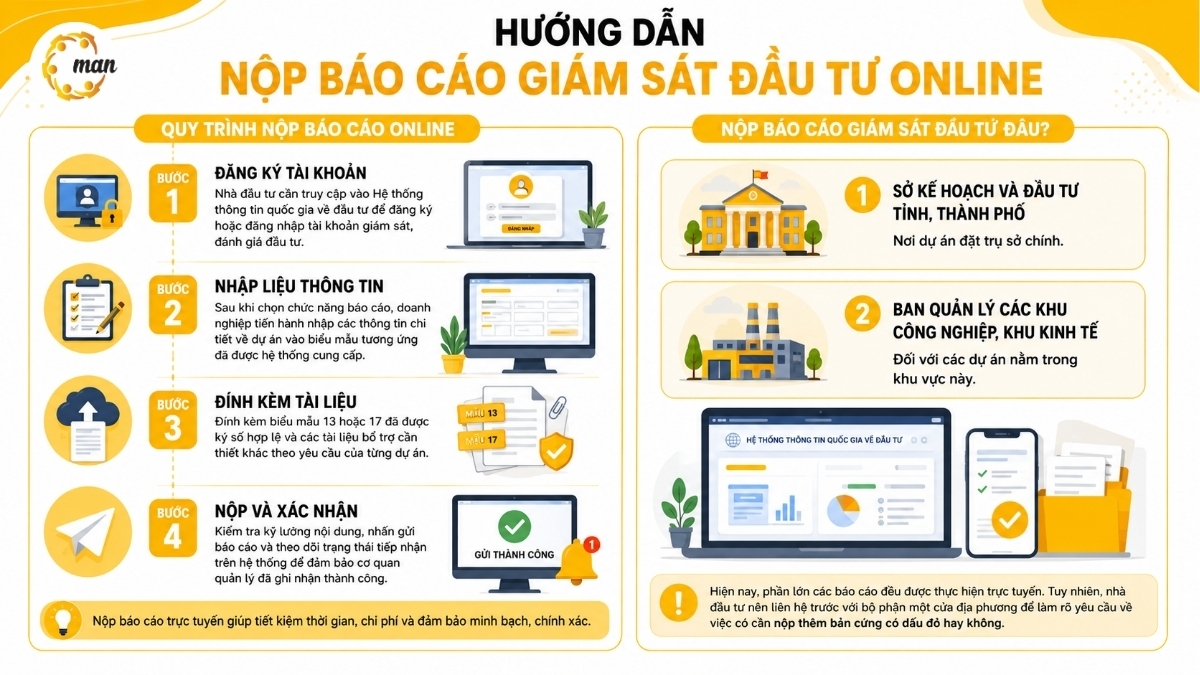
Investment monitoring and evaluation reports are tools for investors to self-assess and track project progress against initial commitments in the Investment Registration Certificate. This is an official information channel for state management agencies to evaluate implementation effectiveness and understand the actual difficulties and obstacles faced by businesses.
The legal basis for this activity includes the Investment Law 2020., Decree 29/2021/ND-CP and Circular 05/2023/TT-BKHĐT. Full compliance with these documents is a mandatory requirement, affirming the investor's seriousness and transparency before the competent authorities. At MAN – Master Accountant Network, we always remind businesses that this report is not merely an administrative procedure but also an opportunity for businesses to acknowledge their efforts in contributing to the local budget and economic development.
Note: Many businesses confuse investment monitoring reports with investment project implementation reports, leading to the submission of incorrect forms or to the wrong receiving agency. This confusion can disrupt the administrative procedures of the project.
Which system should the investment monitoring report be submitted to?
Currently, most investment projects submit investment monitoring and evaluation reports through the National Investment Information System. Investors use the account provided during the project registration process to log in, declare information, and submit reports online.
Typically, the legal representative or an individual authorized by the business will submit reports through the system. If investors forget their login information, they can contact the investment registration authority or technical support department for guidance on recovering their account.
Submitting reports online makes it easier for management agencies to track project progress and significantly reduces processing time compared to traditional methods.
Entities required to submit investment monitoring reports
The scope of entities subject to this reporting regime is very broad. The following entities are required to fulfill their reporting obligations:
- Domestic investors with projects must register their investments.
- Foreign investors holding an Investment Registration Certificate in Vietnam.
- Foreign-invested enterprises are implementing projects.
- The projects are currently in the basic construction phase.
- The projects have entered commercial operation.
Is it possible to amend the Investment Registration Certificate if the investment monitoring report has not yet been submitted?
During the process of amending the Investment Registration Certificate (IRC), the investment registration authority usually checks the enterprise's reporting compliance history. If it is found that the project has not fully complied with the investment monitoring reporting requirements, the application may be requested to provide additional information or explanations before further processing.
According to MAN – Master Accountant Network's experience in supporting FDI enterprises, many cases of capital increase adjustments, changes in project objectives, or schedule modifications have been delayed due to a lack of regular reporting.
Therefore, businesses should review and fulfill all reporting obligations before proceeding with investment project adjustment procedures.
Types of reports and deadlines for submitting investment monitoring reports.
Each reporting period requires investors to prepare updated data according to the legally mandated timelines. Below is a summary table of the types of reports and their corresponding deadlines:
| Report type | Main content | Submission deadline | Legal basis |
|---|---|---|---|
| Six-month report | Project progress schedule | Before July 10th | Circular 05/2023/TT-BKHĐT |
| Annual Report | Summary of project implementation status | Before February 10th of next year | Circular 05/2023/TT-BKHĐT |
| Pre-adjustment report | Re-evaluate the project before making changes. | Before proceeding with the procedures | Decree 29/2021/ND-CP |
| The report concludes. | Overall project completion evaluation | Within 6 months after completion | Decree 29/2021/ND-CP |
In addition to regular reports, establishing an internal reminder schedule will help the accounting or administrative departments of a business stay proactive in preparing data.
Timeline submits annual investment monitoring report.
Monitoring and submitting investment monitoring and evaluation reports on time helps businesses proactively prepare data, reduce the risk of late submission, and avoid unnecessary administrative violations. In reality, many businesses only review their reporting obligations when making adjustments to their Investment Registration Certificates, leading to the need for additional documentation or explanations to the management agency.
Below is a timeline of key milestones that investors need to be aware of during the project implementation process:
| Time | Work performed | Deadline |
|---|---|---|
| January of each year | Prepare annual report data. | Before February 10th of the following year |
| June every year | Summary of performance during the first six months of the year | End of June |
| July every year | Submit the 6-month investment monitoring report. | Before July 10th |
| When making project adjustments | Review the project's reporting obligations. | Before submitting the amendment application |
| When the project ends | Prepare a comprehensive project monitoring and evaluation report. | Within 6 months of project completion. |
In addition to regular reporting periods, investors should establish an internal monitoring schedule between accounting, finance, and legal departments to ensure that data is fully updated before reporting deadlines. This not only helps minimize the risk of penalties but also facilitates future procedures for amending the Investment Registration Certificate or increasing investment capital.
For foreign-invested enterprises (FDI), proactively monitoring the investment supervision report timeline helps maintain a good compliance history with the investment registration authority, thereby limiting delays in processing applications when changes to project objectives, scale, or progress arise.
Latest Investment Monitoring Report Template
According to Circular 05/2023/TT-BKHĐT, The forms used for investment monitoring and evaluation have been standardized to ensure consistency in the management of investment projects nationwide. Using the correct forms helps businesses reduce the risk of their applications being rejected or requiring additional information.
Form No. 13 – Periodic Investment Monitoring and Evaluation Report
Form No. 13 is the most commonly used form for ongoing investment projects. This form is applicable for periodic reporting periods as stipulated by law.
The main information to be declared in Form No. 13 includes:
- Progress of investment project implementation;
- Investor's capital contribution situation;
- Value of disbursed investment capital;
- Revenue and business performance results;
- Status of tax compliance;
- The number of workers currently employed;
- Difficulties, obstacles, and recommendations from businesses.
In practice, the majority of FDI enterprises that submit 6-month and annual reports use Form No. 13 as prescribed by current regulations.
Form No. 17 – Overall Monitoring and Evaluation Report of Investment Projects
Form No. 17 is used for a comprehensive evaluation of the investment project implementation process, especially at the end of the project or at the request of state management agencies.
The content of Form 17 typically focuses on:
- Results of investment project implementation;
- The socio-economic effectiveness of the project;
- The extent to which the registered goals have been achieved;
- Problems and difficulties arising during the implementation process;
- Recommendations and proposals to government agencies.
Compared to Form 13, Form 17 has a broader scope of evaluation and is more comprehensive, covering the entire project implementation process.
When should you use Form 13 and Form 17?
To avoid confusion during the reporting process, businesses can refer to the distinction table below:
| Criteria | Form No. 13 | Form No. 17 |
|---|---|---|
| Investment monitoring report for the first six months. | x | |
| Annual Investment Monitoring Report | x | |
| Periodic report on investment projects | x | |
| Overall monitoring and evaluation report | x | |
| Investment project completion | x | |
| Evaluating the overall effectiveness of the project. | x |
Using the correct form not only facilitates the reporting process but also reduces the risk of having to provide explanations or additional documents when the investment registration authority checks the project's compliance.
Distinguishing between investment monitoring reports and investment project implementation reports.
Many businesses often confuse these two types of reports because they both relate to investment project management. However, the purpose and scope of monitoring for each type of report are different.
| Criteria | Investment monitoring report | Report on the progress of the investment project. |
|---|---|---|
| Purpose | Overall assessment of project effectiveness and implementation status. | Monitor project progress. |
| Content | Investment capital, labor, environment, financial obligations | Construction progress, capital contribution, and project implementation. |
| Scope | Comprehensive | Focus on progress |
| Time of execution | According to reporting period or management requirements | According to investment reporting regulations |
Identifying the correct type of report will help businesses avoid submitting the wrong form or providing inaccurate information as required by regulatory authorities.
Contents that need to be included in the investment monitoring report.
A quality report should fully reflect the project's progress against the registered commitments, including:
- Project progress: Comparison of actual progress with the initial plan.
- Capital contribution status: Value of contributed charter capital.
- Disbursement of investment capital: Status of investment in fixed assets or working capital.
- Revenue and tax obligations: Business results and budget contributions.
- Labor and Social Insurance: Employment situation and benefits for workers.
- Environment and land: Compliance with resource regulations.
- Challenges and recommendations: Propose solutions for support from government agencies.
Through the process of supporting businesses, the team of experts at MAN – Master Accountant Network It is recognized that accurately describing the difficulties and obstacles encountered during project implementation is equally important. This serves as the basis for regulatory agencies to review and provide appropriate guidance and support to investors.
Instructions for submitting investment monitoring reports online.
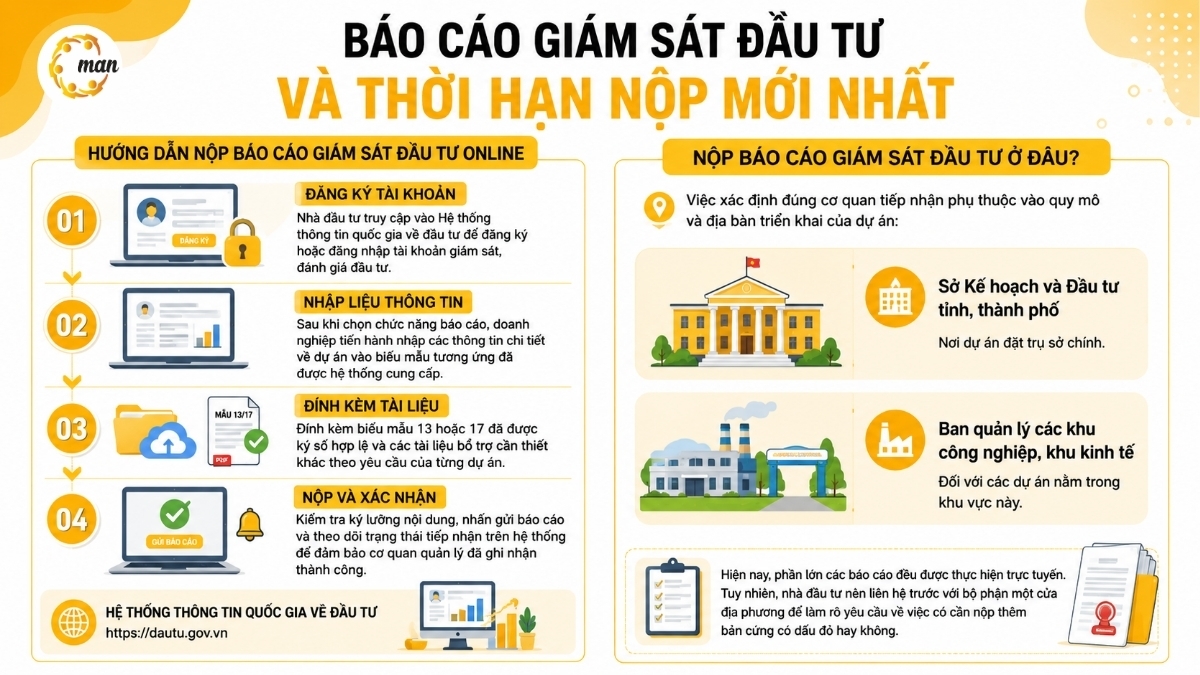
Currently, most businesses submit investment monitoring and evaluation reports through the National Investment Information System. Online submission saves processing time and allows management agencies to track project progress more conveniently.
To avoid errors during the declaration process, investors can follow these steps:
Step 1: Log in to the National Investment Information System
Investors use the account provided during the investment project registration process to access the system. In case of forgotten login information, businesses can contact the investment registration authority or the technical support department for guidance on account recovery.
Before submitting the report, businesses should also check the validity of their digital signatures to ensure a smooth signing and submission process.
Step 2: Select the appropriate reporting period.
After logging in, businesses select the correct type of report they need to generate, including:
- Six-month investment monitoring report;
- Annual investment monitoring report;
- This report is for the purpose of adjusting the investment project.;
- A comprehensive monitoring and evaluation report will be prepared upon project completion.
Choosing the wrong reporting period is one of the common reasons why documents are requested to be corrected or resubmitted.
Step 3: Declare investment project information
Businesses enter the required information using the form provided by the system. The information that needs to be declared typically includes:
- Project progress;
- The situation regarding capital contributions and disbursement of investment funds;
- Revenue and business performance results;
- Number of employees currently employed;
- Financial obligations to the State;
- Difficulties, obstacles, and recommendations from businesses.
Investors should compare the declared figures with financial statements, investment registration documents, and related materials to ensure consistency.
Step 4: Attach the relevant forms and documents.
Depending on the specific case, businesses need to prepare all the necessary documents, such as:
- Form No. 13 on periodic investment monitoring and evaluation reports;
- Form No. 17 on the overall monitoring and evaluation report of investment projects;
- Additional explanatory documents or appendices as required by the regulatory authority.
Using the correct forms as prescribed by current regulations will help reduce the risk of your application being rejected.
Step 5: Digitally sign and submit the report.
After completing the data entry, the business checks all the information before electronically signing and submitting the document to the system.
Investors should monitor the processing status on the National Investment Information System to ensure that the report has been successfully received. In case of any additional requirements or adjustments, businesses should comply promptly to avoid affecting future investment procedures.
In reality, many cases of adjusting Investment Registration Certificates are delayed because businesses have not fully completed their reporting obligations or the declared data is inconsistent with the project's legal documents. Therefore, carefully reviewing information before submitting reports is a crucial step in helping businesses maintain a good compliance history with the investment registration authority.
Where to submit investment monitoring reports?
Identifying the correct receiving agency depends on the scale and geographical scope of the project:
- Department of Planning and Investment of the province/city where the project's head office is located.
- Management Board of Industrial Parks and Economic Zones: For projects located within these areas.
Currently, most reports are submitted online. However, investors should contact the local one-stop service center in advance to clarify whether additional hard copies with official stamps are required.
Common mistakes when submitting investment monitoring reports.
In reality, many businesses are required to correct or supplement their documents due to basic errors made during the declaration process.
Some common mistakes include:
- Choose the wrong reporting period: either 6 months or an annual report.
- Using this form is no longer valid.
- The capital contribution figures do not match the investment registration documents.
- Revenue and tax obligations are not consistent with financial statements.
- Missing digital signature or invalid electronic signature.
- The attached document is incorrect or an unreadable file.
- The report was submitted after the deadline.
To mitigate risks, businesses should cross-check data between investment reports, financial statements, and project legal documents before submitting them to the system.
Penalties for violations related to failure to submit investment monitoring reports.
The implementation of investment monitoring and evaluation reports is not only a routine management obligation but also a mandatory requirement for investment projects under current regulations. Businesses that fail to comply or comply incorrectly may be subject to administrative penalties. Decree 122/2021/ND-CP.
Below are some common violations and their corresponding penalties:
| Violation | Fine amount |
|---|---|
| Failure to submit periodic reports. | 50,000,000 – 70,000,000 VND |
| Submitting reports late | 20,000,000 – 30,000,000 VND |
| The report contains inaccurate information. | 30,000,000 – 50,000,000 VND |
What is the penalty for late submission of investment monitoring reports?
Businesses that submit reports after the deadline may be fined from 20 million VND to 30 million VND, depending on the nature and severity of the violation.
In reality, many businesses only discover missing reports when they go through the procedure of amending their Investment Registration Certificate or increasing their investment capital. At that point, businesses usually have to fulfill their reporting obligations again before their application can be further considered.
What is the penalty for not submitting an investment monitoring report?
Failure to comply with the prescribed periodic reporting requirements may result in administrative penalties ranging from 50 million VND to 70 million VND.
This is one of the relatively high penalties in the investment sector and often directly affects the process of carrying out subsequent administrative procedures for the project.
Will reporting false information result in penalties?
Yes. If a business provides false information regarding investment capital, revenue, labor, or other indicators in its reports, the regulatory authority may impose a fine ranging from 30 million VND to 50 million VND according to current regulations.
Therefore, businesses should compare the data between the investment report, financial statements, and legal documents of the project before submitting them to minimize potential risks.
Besides fines, what other impacts do businesses face?
In addition to administrative penalties, failure to fully fulfill reporting obligations can lead to many other consequences such as:
- Extending the processing time for applications to amend Investment Registration Certificates;
- Being asked to provide explanations or supplementary information regarding missing reporting obligations;
- This creates difficulties when carrying out procedures for increasing investment capital or changing project objectives;
- This affects the company's compliance history with the investment registration authority.
Therefore, monitoring periodic reporting deadlines and preparing complete data from the outset will significantly help businesses mitigate legal risks during the implementation of investment projects.
Frequently Asked Questions about Investment Monitoring Reports
Do businesses that have not yet generated revenue need to submit investment monitoring reports?
How often are investment monitoring reports submitted per year?
Is it necessary to submit a paper copy after submitting the report online?
Is it possible to amend the Investment Registration Certificate if the investment monitoring report has not yet been submitted?
Are FDI enterprises required to submit investment monitoring reports?
What is the penalty for late submission of investment monitoring reports?
How do Form No. 13 and Form No. 17 in the investment monitoring report differ?
What is the difference between an investment monitoring report and a project implementation report?
What should I do if I forget my password for the National Investment Information System?
Does a project that has temporarily suspended operations still need to submit an investment monitoring report?
Is it possible to submit supplementary investment monitoring reports from previous years?
Conclude
Submitting investment monitoring reports on time and accurately demonstrates a company's professionalism and compliance with the law. To optimize this process, businesses can refer to guidelines from MAN – Master Accountant Network or contact consulting firms directly for assistance in verifying data accuracy before submitting reports to government agencies.
Contact information for MAN – Master Accountant Network
- Address: 19A, 43rd Street, Tan Thuan Ward, Ho Chi Minh City
- Mobile/Zalo: 0903 963 163 – 0903 428 622
- Email: man@man.net.vn
Content production is overseen by: Mr. Le Hoang Tuyen – Founder & CEO of MAN – Master Accountant Network, CPA Vietnam auditors with over 30 years of experience in accounting, auditing, and financial consulting.