





The fact that a company has not generated revenue does not necessarily mean that it has not achieved its investment project objectives. When assessing the project's status, businesses need to compare the registered objectives, scale, and progress with the actual implementation situation, especially in the context of the Investment Law No. 143/2025/QH15, which came into effect on March 1, 2026.
If a company has no revenue, is it considered to have failed to meet its project objectives?
No. The fact that a business has no revenue, low revenue, or is in the investment phase is not the only basis for concluding that the business is not achieving its investment project objectives.
Legally, it is necessary to distinguish between business results and the achievement of project objectives. A project may be in the stages of site preparation, construction, machinery installation, recruitment, testing, or completing the conditions for operation, and therefore has not yet generated revenue, but is still undergoing actual implementation.
What factors are used to evaluate the objectives of an investment project?
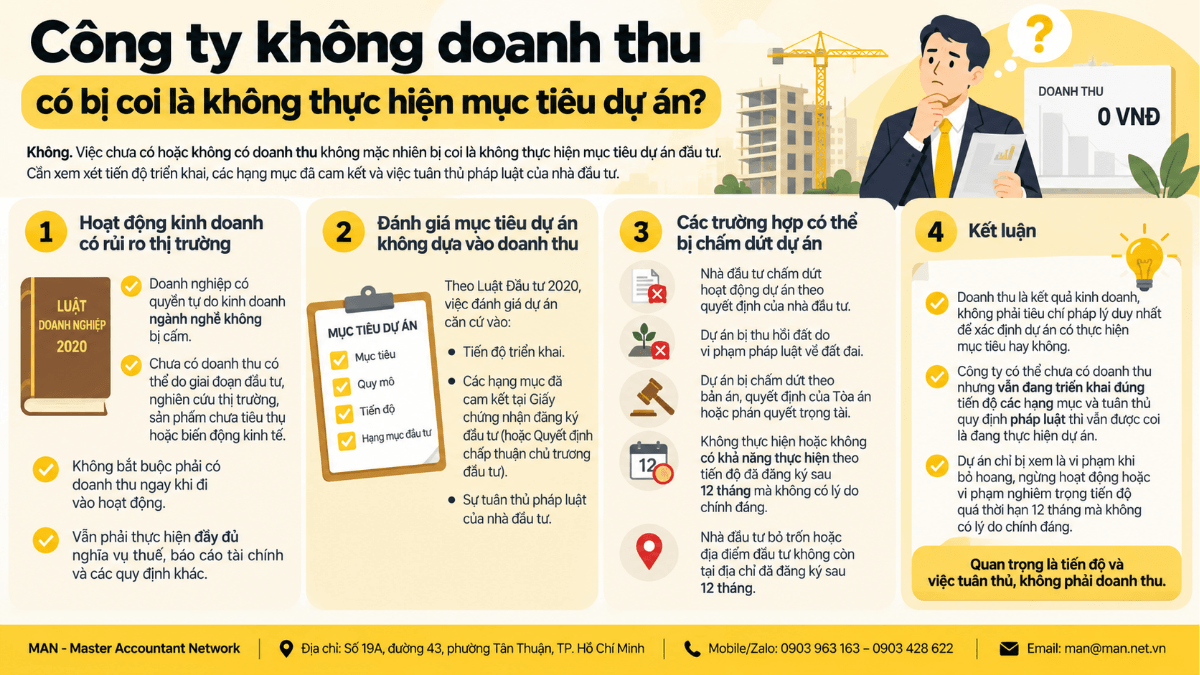
The investment project's objectives are one of the core aspects that investors need to monitor throughout the implementation process. Information regarding objectives, scale, capital, and progress is recorded in the project dossier and, in the case of an Investment Registration Certificate (IRC), is included in this document.
According to the information above. IRC Investment Registration Certificate and the latest regulations 2026, The IRC records important project information such as objectives, scale, funding, and implementation schedule.
When reviewing a non-revenue generating project, businesses should focus on the following groups of information:
- Registered operational objectives: whether the business is operating in accordance with the registered type, industry, and output.
- Progress: whether milestones such as capital contribution, construction, completion of project components, commissioning, or other phases are being implemented on schedule.
- Scale and location: Is the project being implemented at the exact location, scale, and scope as registered?.
- Status of actual implementation: whether there are investment activities, investment preparation, construction, asset procurement, recruitment, or other activities consistent with the project.
No revenue is the same as not achieving project goals.
Revenue is an indicator reflecting business results, while investment project objectives are the legal content associated with the registered investment activity. These two concepts are related but cannot be considered identical.
| Status | It is understandable. | Points that need review |
| No revenue yet. | No revenue has been generated or recorded yet. | Project progress and implementation activities |
| Low revenue | Business performance has not met expectations. | Objectives, scale, and actual operating conditions |
| The goal has not been achieved. | The registration goal has not been achieved. | Milestones and the possibility of schedule adjustments. |
| The project was not implemented. | There are signs that the project is not being implemented. | Reasons, timeframe, and grounds for project termination. |
Therefore, revenue targets should be viewed as data on business performance, not the sole measure of whether a project is achieving its objectives.
When can failure to meet project objectives lead to project termination?
From March 1st, 2026, Law No. 143/2025/QH15 on Investment will be the current legal basis for investment. According to Clause 2, Article 36, the investment registration authority may terminate or partially terminate a project's operations in various cases, including when the investor fails to achieve the registered operational objectives.
Notably, point b, clause 2, Article 36 stipulates that: after 24 months from the completion of the project's operational objectives or the objectives of each phase, if the investor still fails to achieve the objectives and does not fall under the cases eligible for schedule adjustment as prescribed, the project or a part of the project may be terminated.
In addition to cases related to target progress, Article 36 also stipulates several other grounds. When reviewing risks, businesses should note:
- The project falls under the category requiring suspension of operations, but the investor is unable to remedy the conditions for suspension.
- The investor is no longer able to use the investment site and fails to complete the site adjustment procedures within the legally prescribed time limit.
- The project has ceased operations, and more than 12 months have passed without the investment registration authority being able to contact the investor or their legal representative.
- The project falls under the category of land reclamation, the investor fails to fulfill the deposit obligation, or other cases as stipulated in Article 36.
What should be done when a business has no revenue?
If a project has not yet generated revenue but is still under development, businesses should not rely solely on revenue reports to assess compliance. Instead, they should review both the project's legal documentation and the actual situation.
A fact-checking process can be carried out in the following steps:
- Compare the project objectives stated in the IRC or the investment approval document with the actual operations.
- Review each registered progress milestone, identify which milestones have been completed, which are behind schedule, and the reasons for the delay.
- Review the status of capital contributions, site, construction, asset procurement, personnel, and other activities related to project implementation.
- If the objectives or actual progress have changed, determine whether a project adjustment procedure or an IRC adjustment is necessary.
If adjustments to project information are needed, businesses can refer to the following. What does an IRC amendment dossier include according to the 2026 regulations? To compare the required document groups based on the changes.
When is it necessary to adjust project goals or timelines?
During implementation, investors have the right to adjust the project in accordance with the law. According to Article 33 of the 2025 Investment Law, investors may adjust the objectives and other contents of the project in accordance with regulations; if the adjustment changes the main content of the IRC, the procedure for adjusting the IRC must be followed.
For projects subject to investment policy approval, certain changes such as changes or additions to objectives requiring approval, changes in location, extensions beyond legally stipulated limits, or adjustments to the operating period may necessitate procedures for approving adjustments to the investment policy.
Businesses can refer to this for more information. Procedures for amending Investment Certificates under the 2025 Investment Law To determine the appropriate course of action to address the changes in the project.
MAN's perspective on investment project objectives.
From a compliance management perspective, the key concern is not whether the business has generated revenue yet, but whether the project is being implemented in line with the registered objectives and schedule.
A business that has not yet generated revenue may still be undertaking a project if it has appropriate implementation activities and has not fallen into any legally binding termination categories. Conversely, a business that has revenue but whose actual operations do not conform to its registered objectives, scale, location, or schedule may still face compliance risks.
Conclude
A company with no revenue is not automatically considered to have failed to achieve its investment project objectives. To properly assess the project's status, it is necessary to consider operational goals, progress, scale, location, and actual implementation activities, rather than just looking at revenue.
Specifically, from March 1, 2026, the Investment Law No. 143/2025/QH15 needs to be applied. Businesses should proactively review progress milestones and carry out adjustment procedures when targets or actual progress change, avoiding prolonged delays that could lead to project termination.
Legal source: Investment Law No. 143/2025/QH15 – full text and Articles 33 and 36. Law Library.
Professional license: CPA Vietnam Auditors
Experience: Over 30 years of experience in Accounting, Auditing, and Financial Consulting.