




Many foreign investors entering Vietnam often wonder whether to establish a foreign direct investment (FDI) company or have a Vietnamese national register a domestic company. These two models differ significantly in legal procedures, capital ownership, profit transfer capabilities, and business conditions. Identifying the correct model from the outset helps avoid unnecessary problems and optimize operating costs.
What are FDI companies and Vietnamese companies?
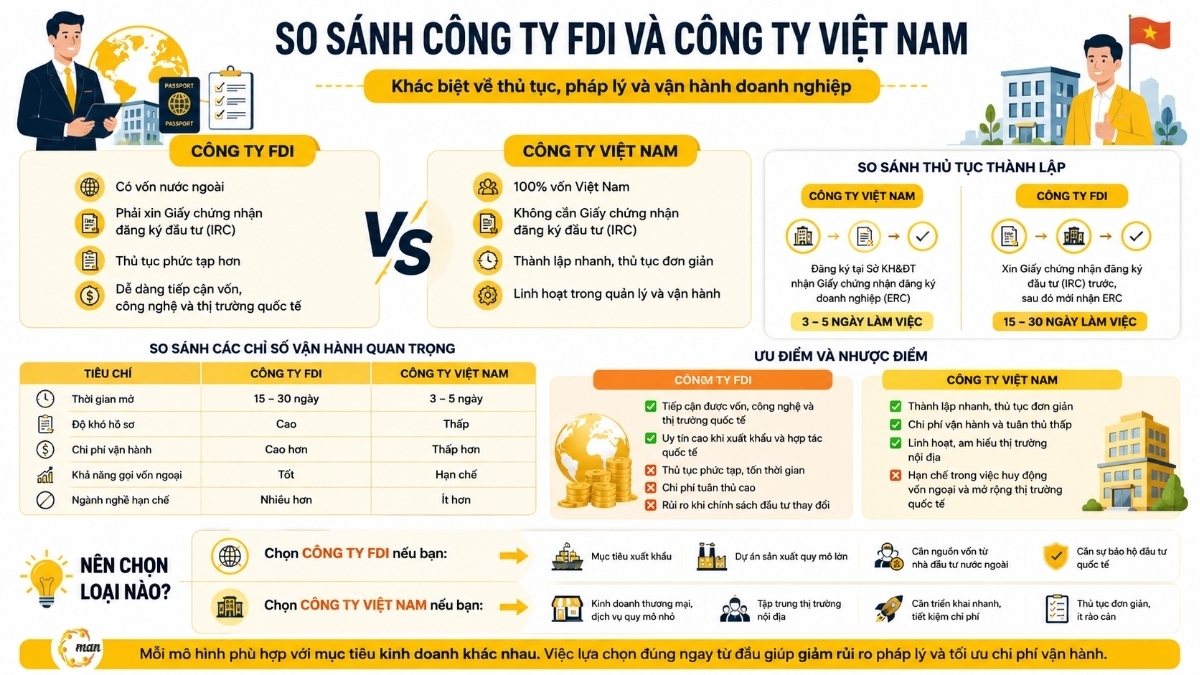
Foreign direct investment (FDI) companies are businesses with capital contributions or ownership from foreign individuals or organizations. This type of business is subject to strict regulations under the Investment Law, with specific licensing procedures.
A Vietnamese company is a domestic-owned enterprise that is not classified as a foreign-invested enterprise. This is a common business model with a flexible management mechanism and fewer administrative barriers compared to foreign-invested enterprises.
Comparison of FDI companies and Vietnamese companies
| Criteria | FDI company | Vietnamese company |
|---|---|---|
| Owner | Foreign-owned | 100% is a Vietnamese-owned company. |
| Investment Certificate | Involving Required (IRC) | No need |
| Date of establishment | Longer | Faster |
| Restricted occupations | More | Less |
| Profit sharing | Specific regulations | More flexible |
The table above summarizes the core differences. Based on our consulting experience. MAN – Master Accountant Network, The biggest challenge for foreign investors is proving their financial capacity and explaining their project, while Vietnamese companies benefit from much faster and more streamlined procedures under the regulations. National portal for business registration.
Comparing key performance indicators
| Criteria | FDI company | Vietnamese company |
|---|---|---|
| Opening hours | 15-30 days | 3-5 days |
| Difficulty of application | High | Short |
| Operating costs | Higher | Lower |
| The ability to attract foreign investment. | Good | Limit |
Comparison of establishment procedures
Establishing a company in Vietnam is a streamlined process; you only need to register with the Department of Planning and Investment to receive the Enterprise Registration Certificate (ERC). You can start operating in just 3 to 5 business days. price list for business registration services detail.
Conversely, FDI companies have to go through the licensing process. What is IRC? Before receiving the ERC, investors need to explain the project, demonstrate financial capacity, and meet market access requirements. application for an investment certificate. MAN – Master Accountant Network often assists foreign investors in preparing this documentation to avoid repeated requests for clarification from authorities.
What are the limitations faced by FDI companies, and what advantages do Vietnamese companies have?
Foreign direct investment (FDI) companies benefit from investment protection commitments under international agreements. However, a major obstacle lies in the business sectors. Some FDI sectors are subject to limitations on ownership ratios and strict controls on investment conditions.
Conversely, domestic businesses have full freedom to operate in sectors where FDI is restricted. Procedures for changing information, transferring capital, or adjusting business lines of Vietnamese companies are also carried out quickly, without the need for investment appraisal.
Comparing taxes and investment incentives
Both types of businesses comply with general regulations on corporate income tax and value-added tax. However, FDI businesses often face complex reporting requirements regarding transfer pricing and cross-border money flow control.
The common point is that both receive corporate income tax incentives when investing in high-tech or clean agriculture. The difference is that incentives for FDI often come with strict commitments regarding the investor's project disbursement schedule.
Working and operating environment
FDI companies typically operate according to KPIs, processes, and internationally standardized reporting systems. This is a professional environment, but it can be quite rigid with cumbersome reporting structures.
Meanwhile, Vietnamese businesses are more flexible. Their management style is often based on family ties or personal relationships, allowing for more adaptable handling of local situations compared to the rigid FDI model.
Assessing the practical advantages and disadvantages
Choosing between adapting to local customs with the FDI model or pursuing a quick victory with a Vietnamese company should be based on your specific practical needs:
For FDI companies:
- Highlights: Access to foreign capital, advanced technology, and a strong reputation in exports.
- Cons: Extremely stringent compliance procedures, high administrative costs, and risks if investment policies change.
For Vietnamese companies:
- Highlights: Rapid registration process, low maintenance costs, and in-depth knowledge of the local market help you resolve any issues quickly.
- Cons: Limited capacity to raise foreign capital and difficulties in competing fairly in demanding markets that require international standards.
Should you choose a foreign direct investment (FDI) company or a Vietnamese company?
If your goal is to tap into the domestic market with simple procedures, a Vietnamese company is the optimal choice. If your goal is to export, connect to global supply chains, or receive foreign capital, you need to choose an FDI structure to ensure long-term legal compliance.
For example, a large-scale manufacturing plant requiring international investment protection will certainly have to go through FDI procedures. Conversely, if you are engaged in small-scale trade or services, a Vietnamese company will save you months of waiting for permits.
Conclude
Each model suits different business objectives. If rapid expansion and flexible operation are needed, a Vietnamese company is often the optimal choice. Conversely, FDI is suitable for projects requiring foreign capital, exports, or international expansion. Hopefully, this practical analysis from MAN – Master Accountant Network will help you make the right decision. If you need further assistance, please contact our experts for advice on an effective roadmap.
Contact information for MAN – Master Accountant Network
- Address: 19A, 43rd Street, Tan Thuan Ward, Ho Chi Minh City
- Mobile/Zalo: 0903 963 163 – 0903 428 622
- Email: man@man.net.vn
Content production is overseen by: Mr. Le Hoang Tuyen – Founder & CEO of MAN – Master Accountant Network, CPA Vietnam auditors with over 30 years of experience in accounting, auditing, and financial consulting.