





Professional license: CPA Vietnam Auditors
Experience: Over 30 years of experience in Accounting, Auditing, and Financial Consulting.
The 2025 Investment Law introduces significant adjustments to policies for attracting capital and managing investment projects in Vietnam. This article summarizes the core changes, provides a detailed comparison with the 2020 Investment Law, and offers implementation guidance from legal experts at MAN – Master Accountant Network.
Quick summary: Investment Law No. 143/2025/QH15 Article 28 supplements special investment procedures, establishes an Investment Support Fund, decentralizes the authority to approve investment policies, and reforms project management mechanisms to facilitate investment in Vietnam.
What is the Investment Law 2025?
Law No. 143/2025/QH15 on Investment was passed by the National Assembly on December 11, 2025, and came into effect on March 1, 2026, replacing the 2020 Law on Investment. The document regulates investment and business activities in Vietnam and investment activities from Vietnam to overseas.
Scope of regulation
According to Article 1 of Law No. 143/2025/QH15, the scope of regulation includes investment and business activities of investors within the territory of Vietnam and investment and business activities from Vietnam abroad. The Law specifies the conditions for investment and business, conditional market access sectors for foreign investors, investment forms, investment incentives and support policies, as well as state management of investment activities.
Applicable subjects
The 2025 Investment Law applies to domestic investors, foreign investors, economic organizations with foreign investment capital, state management agencies on investment, and other organizations and individuals involved in investment and business activities. The new regulations expand support policies for FDI enterprises, high-tech enterprises, and entities participating in strategic supply chains.
Key new features of the 2025 Investment Law
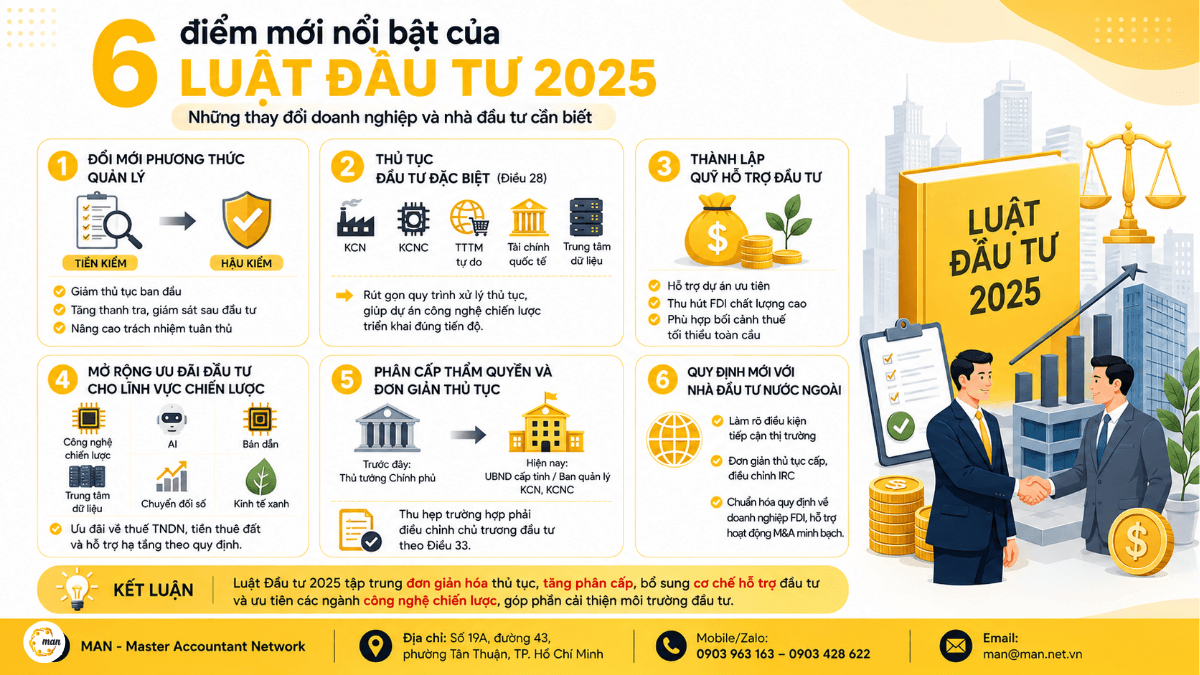
Law No. 143/2025/QH15 adds notable changes including special investment procedures in Article 28, the establishment of an Investment Support Fund, decentralization of authority to approve investment policies, and standardization of regulations applicable to foreign investors.
Innovate the methods of managing investment conditions.
The spirit of Law No. 143/2025/QH15 reflects a shift in state management methods from pre-licensing inspections to enhanced post-operation inspections and supervision. Based on regulations concerning investment and business conditions and special investment procedures, investment registration agencies reduce initial procedures, facilitating rapid project implementation by investors, while simultaneously enhancing accountability for self-compliance and application. Sanctions for violations during operation.
Special investment procedures
Based on Article 28 of the 2025 Investment Law, special investment procedures are applied to certain projects located in industrial parks, high-tech zones, free trade zones, international financial centers, and data centers. This mechanism optimizes the administrative procedure process, bypassing some unnecessary pre-appraisal steps, helping strategic technology projects to be implemented on schedule.
Investment Support Fund
The supplementary law stipulates the establishment of an Investment Support Fund to support certain priority sectors and projects as defined by the Government. The establishment of this Fund provides an important legal basis and is expected to contribute to attracting high-quality FDI and supporting businesses in meeting standards in the context of global minimum tax enforcement.
Investment incentives and support for strategic sectors.
Investment incentives and support policies are being expanded to focus on strategic technology sectors, digital transformation, semiconductor industry, data centers, artificial intelligence, and the green economy. Businesses investing in these sectors enjoy preferential corporate income tax rates, land lease fees, and infrastructure support within the current regulatory framework.
Project adjustment procedures and authority hierarchy
The 2025 Investment Law promotes decentralization and delegation of authority in handling administrative procedures. Many powers previously under the Prime Minister's authority to approve investment policies are now delegated to the Chairman of the Provincial People's Committee or the Management Board of industrial parks and high-tech zones. In addition, according to Article 33, some cases of changes in capital scale or project content no longer require the procedure for adjusting investment policies; businesses need to compare each specific condition to determine their obligations.
New regulations for foreign investors
For economic organizations with foreign investment capital, Law No. 143/2025/QH15 clarifies market access conditions and simplifies procedures for granting and adjusting licenses. Investment Registration Certificate (IRC). Equity ownership ratio And the process of identifying FDI enterprises that meet investment conditions, such as those for foreign investors, is standardized, supporting transparent M&A activities.
Comparison of the 2025 Investment Law and the 2020 Investment Law
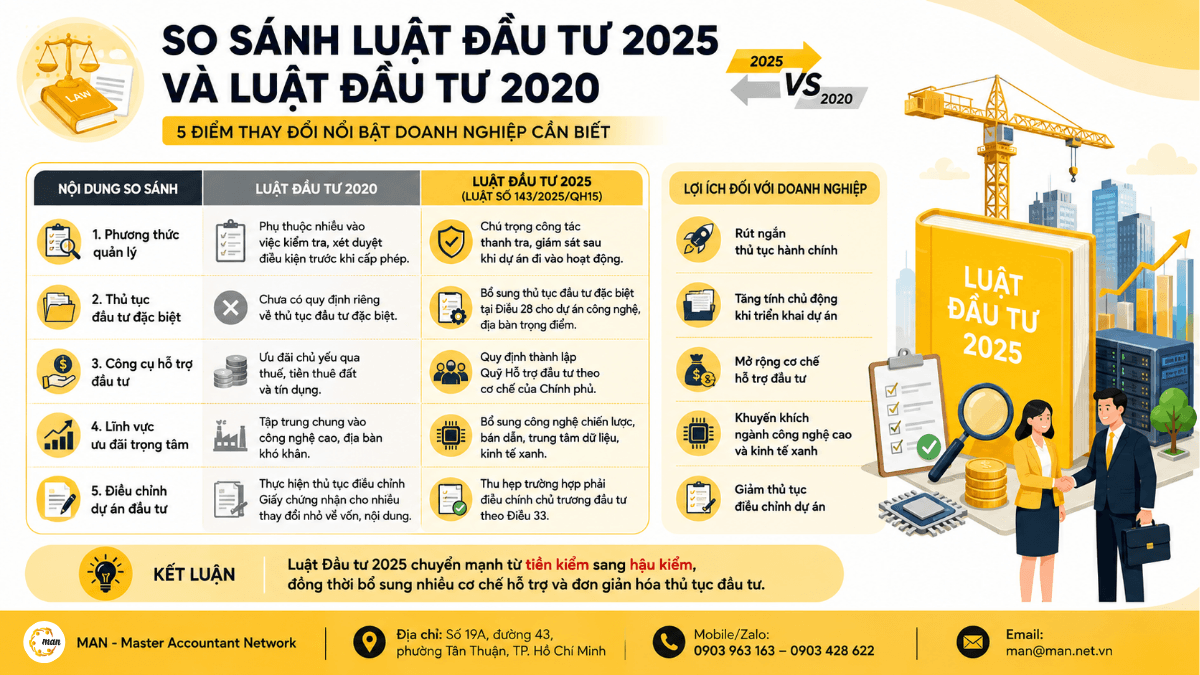
Compared to the 2020 Investment Law, the 2025 Investment Law adds new provisions aimed at simplifying administrative procedures, decentralizing approval authority, and improving post-audit management mechanisms, creating a comprehensive legal basis for investment activities.
The table below summarizes the core differences between the two legal texts:
| Comparison content | Investment Law 2020 | Investment Law 2025 (Law No. 143/2025/QH15) | Actual impact on businesses |
|---|---|---|---|
| Management method | It heavily depends on the inspection and review of conditions before granting a license. | Emphasis should be placed on inspection and supervision after the project becomes operational. | Shortening the time to market requires businesses to standardize their compliance practices. |
| Special investment procedures | There are no specific regulations regarding special investment procedures. | Add special investment procedures to Article 28 for technology projects and key geographical areas. | This helps to shorten the administrative procedures for eligible projects. |
| Investment support tools | The incentives are mainly provided through taxes, land rent, and credit. | Regulations for establishing Investment Support Funds are based on mechanisms stipulated by the Government. | Creating a legal framework to increase the attractiveness of FDI flows in the context of applying global minimum tax rates. |
| Priority areas | Focus generally on high technology and challenging geographical areas. | Adding strategic technologies, semiconductors, data centers, and the green economy. | Directing capital flows towards core technologies and sustainable development. |
| Adjusting the investment project | The procedure involves adjusting the Certificate of Ownership to reflect numerous minor changes in capital and content. | Narrow down the cases requiring adjustments to investment policies according to Article 33. | Reduce the burden of administrative procedures arising during project operation. |
What should businesses do when the 2025 Investment Law comes into effect?
Businesses need to review the list of business sectors, investment conditions, procedures for issuing or amending Investment Registration Certificates (IRCs), and develop a record-keeping mechanism to facilitate monitoring and post-auditing in accordance with the new regulations.
Impact on domestic businesses
Domestic businesses benefit from optimized licensing processes and decentralization of authority to local governments. National Public Service Portal. When the burden of pre-approval is minimized, the time required to complete initial legal procedures is shortened, allowing businesses to be more proactive in their implementation progress.
Impact on FDI enterprises
Foreign direct investment (FDI) businesses are subject to many new regulations regarding market access and conditions for granting investment registration certificates. In addition to understanding these regulations thoroughly... the legal nature of the IRC, Furthermore, the post-audit monitoring mechanism requires FDI enterprises to maintain accurate accounting, tax, and investment reporting records, ensuring legal compliance throughout their operations.
Impact on high-tech businesses
Businesses operating in the semiconductor, artificial intelligence, data center, and strategic technology sectors have the opportunity to access preferential policies and special investment procedures under Article 28. Investment conditions in high-tech zones and free trade zones are also more clearly defined.
Things businesses should review
To ensure legal compliance and proactively adapt to the new regulatory framework, businesses need to focus on the following key review areas:
- Review the list of business activities: Compare this with the updated list of conditional market access sectors under the new law.
- Assess the conditions for project adjustment: Examine the capital, technology, and progress parameters as stipulated in Article 33 to determine whether the project is exempt from the procedure for adjusting the investment policy.
- Optimizing legal time and costs: Learn more Time and cost of issuing an Investment Registration Certificate To create accurate financial plans and implementation schedules.
- Update the post-audit compliance regulations: Establish procedures for archiving legal documents and fulfill all periodic reporting obligations. National Investment Information System.
Example of a real-world application scenario.
Note: The examples below are intended only to illustrate the application of the provisions of the 2025 Investment Law and do not replace the assessment of the legal documentation of each specific project.
| Real-life situation | The mechanism is applied according to the Investment Law 2025. | Results of procedure implementation |
|---|---|---|
| Group A (FDI): A semiconductor chip manufacturing project with a total investment of $300 million has been registered in the High-Tech Park. | Apply Special investment procedures As stipulated in Article 28 of the 2025 Investment Law, this applies to strategic technology projects in preferential areas. | Following the procedures for special investment as stipulated in Article 28 simplifies some pre-appraisal steps. |
| Company B (FDI): Operating an electronics components factory, they decided to adjust the scale of capital investment and production technology. | Review the regulations in Article 33 of the 2025 Investment Law regarding cases of investment project adjustment. | In cases where the investment policy is exempt from adjustment, the enterprise must update the information on the National Investment Information System. |
Expert opinion from MAN
Three common misconceptions about the 2025 Investment Law.
Shifting to "post-inspection" does not mean loosening management. In fact, regular and unscheduled inspections and audits will be carried out more rigorously, requiring businesses to strictly adhere to their investment commitments.
Special investment procedures are not automatically applied to all technology projects. This mechanism only applies to projects that simultaneously meet the conditions regarding location (industrial parks, high-tech zones, free trade zones, etc.) and strategic technology sectors as stipulated in Article 28.
Changes to capital or project content do not automatically exempt businesses from the adjustment procedure in all cases. Businesses need to accurately base their actions on the criteria in Article 33 of the 2025 Investment Law to fulfill their legal obligations.
Perspectives from the practical experience of investment project consulting.
Practical experience in implementing FDI projects in Vietnam shows that the biggest challenge for foreign investors is ensuring consistency between investment law, tax regulations, and accounting systems. The 2025 Investment Law offers more flexibility in initial licensing procedures, but places high responsibility on the accounting documentation system, tax obligations, and periodic reporting arising during operation.
Recommendations for businesses before project implementation.
The team of legal and tax accounting experts at MAN – Master Accountant Network provides practical recommendations for investors before officially launching their projects:
- Prepare a Legal Impact Assessment before submitting an application for new project approval or project modification.
- Prepare complete documentation demonstrating financial and technological capabilities to meet post-audit requirements.
- Businesses should consult with experts when a project involves FDI or falls under the category of projects subject to special investment procedures to ensure consistent legal compliance.
Conclude
The 2025 Investment Law (Law No. 143/2025/QH15) creates a more favorable legal framework for investment activities, attracting high-quality capital and improving the efficiency of state management. Understanding the new points regarding special investment procedures, post-audit mechanisms, and preferential conditions will help businesses proactively develop safe business plans that comply with legal regulations.
Frequently Asked Questions about the 2025 Investment Law
When will the 2025 Investment Law come into effect?
According to Clause 1, Article 75 of the Investment Law No. 143/2025/QH15, the Law was passed by the National Assembly on December 11, 2025 and officially came into effect on March 1, 2026.
What's new in the 2025 Investment Law compared to the 2020 Investment Law?
The 2025 Investment Law adds special investment procedures, regulates the Investment Support Fund, shifts the management mechanism to post-audit, expands incentives for strategic technology sectors, and narrows the cases requiring project adjustment procedures.
Which projects are subject to special investment procedures?
The special investment procedures stipulated in Article 28 apply to investment projects located in industrial parks, high-tech zones, free trade zones, international financial centers, data centers, and projects in strategic technology sectors such as semiconductors and artificial intelligence.