




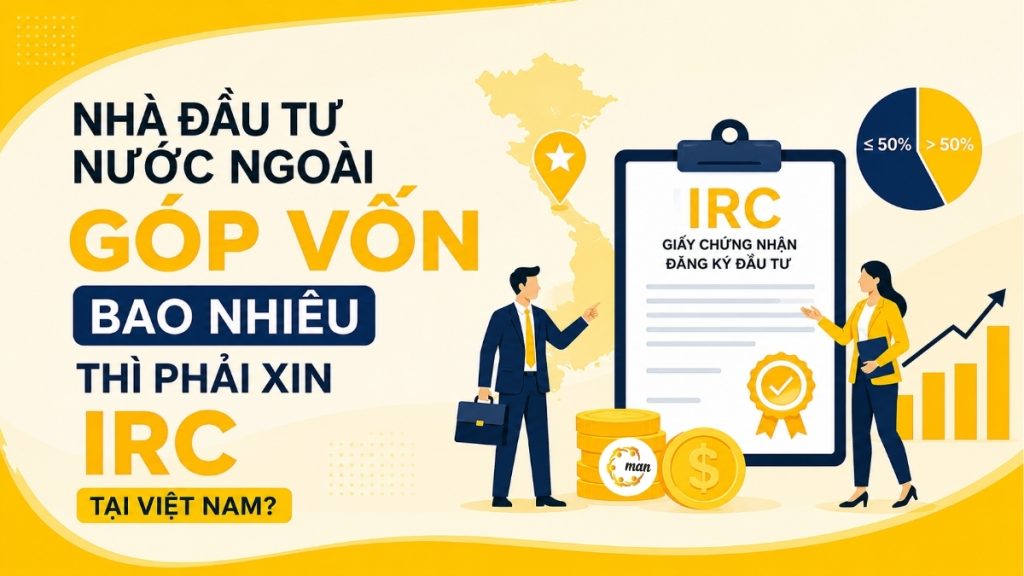
Many foreign investors, when exploring the Vietnamese market, often assume that only large capital contributions or majority ownership require an Investment Registration Certificate (IRC). However, in reality, legal regulations are not based on the amount of investment but directly depend on the ownership percentage and business sector. Simply exceeding the 50% capital threshold may subject your business to all the stringent investment conditions and procedures applicable to foreign investors.
Overview of the IRC Investment Registration Certificate
An investment registration certificate is a document recording the investor's registration information regarding an investment project in Vietnam, in either paper or electronic form. According to regulations... Investment Law 2020, This is a mandatory initial step for foreign direct investment projects that require licensing. The IRC plays a role in verifying the legality of the project, allowing foreign investors to bring capital into business operations in a legitimate and safe manner.
Possessing this license allows foreign-invested enterprises to demonstrate the legitimate source of their funds. It is also a mandatory requirement for banks to accept direct investment accounts. Understanding the legal boundaries of this license will help businesses save on administrative costs and expedite the start of their business operations in Vietnam.
Foreign investors must apply for an IRC (Investment Regulatory Commission) for the amount of capital they contribute.
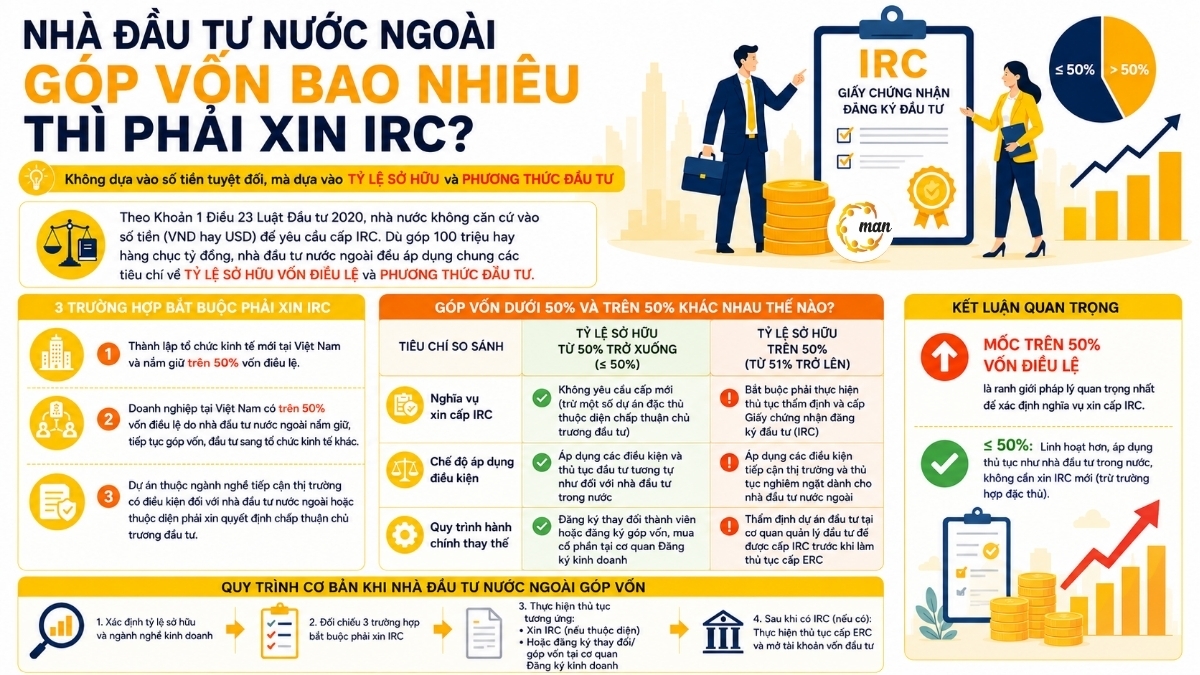
When researching legal regulations, the question of how much capital a foreign investor must contribute to be eligible for an Investment Regulatory Certificate (IRC) is always a top concern for FDI businesses. Based on current legal documents, especially the provisions in Clause 1, Article 23 of the 2020 Investment Law, state agencies do not base their requirements for IRC issuance on the absolute amount of billions of VND or USD. Investors, whether contributing one hundred million VND or tens of billions of VND, are subject to the same criteria regarding ownership ratios and investment methods.
To thoroughly address the question of how much foreign investment requires an Investment Regulatory Commission (IRC), we need to examine investment activities from the perspective of controlling voting rights and the legal nature of the enterprise after receiving investment. This management process is concretized through the clear division of capital ownership groups.
To help economic organizations easily compare their projects with the regulations of the management agency, current law stipulates that foreign investors are required to apply for an IRC in the following three core cases:
- This applies to cases where a foreign investor establishes a new economic organization in Vietnam and holds more than 50% of the charter capital of that economic organization.
- In the case of businesses already established in Vietnam but with more than 50% of their charter capital held by foreign investors, they may continue to invest or contribute capital to another economic organization.
- This applies to investment projects by foreign investors that fall under the category of sectors with conditional market access for foreign capital flows or require approval of investment policy from competent state agencies.
What is the difference between contributing capital under 50% and above 50%?
To select the most optimal investment option in terms of time and administrative procedures, a visual comparison between the two ownership thresholds is crucial. This threshold clearly defines whether a business will be legally treated as a domestic or foreign investor. When do I need to request an IRC? in the most accurate way possible.
The table below details the differences in legal obligations and administrative procedures based on the percentage of foreign ownership in Vietnam:
| Comparison criteria | Ownership ratio of 50% or less | Ownership ratio on 50% (from 51% onwards) |
|---|---|---|
| Obligation to apply for an IRC | No new licenses are required (except for certain specific projects subject to investment policy approval). | It is mandatory to carry out the appraisal procedure and issue the Investment Registration Certificate. |
| Conditional application mode | The same investment conditions and procedures as those applied to domestic investors will be applied. | Applying strict market access conditions and procedures for foreign investors. |
| Alternative administrative procedures | Register changes in membership or register capital contributions/share purchases directly at the Business Registration Authority. | Conduct an investment project appraisal at the investment management agency to obtain an IRC before proceeding with the ERC application. |
Information from the comparison table above shows that the milestone of 50% registered capital is the most important legal boundary for determining the obligation to apply for an IRC. When a foreign investor reaches a 51% or higher ownership stake in a business, that business will essentially be subject to the same investment conditions as a foreign individual or organization.
Consequently, any subsequent business expansion or subsidiary establishment must strictly adhere to the new investment licensing process. Conversely, maintaining an ownership stake of 50% or less gives the business much more flexibility in mergers, acquisitions, and capital restructuring without needing to apply for a new IRC.
When are foreign investors required to apply for an IRC?
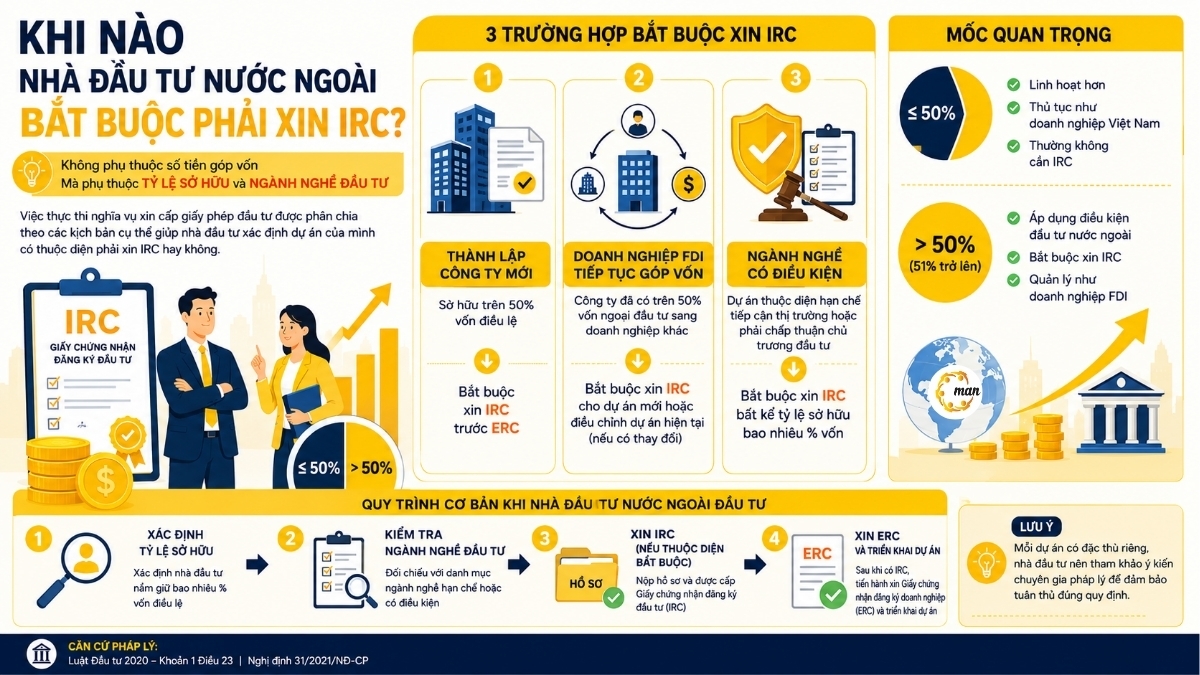
To delve into practical details, the process of applying for an investment license is divided into the following specific investment scenarios. This division helps lawyers and investment consultants easily identify their clients' cases and determine whether their projects require an IRC in each specific instance.
Establish a new economic organization holding over 50% of charter capital.
This is the most common scenario when foreign corporations want to establish a completely new legal entity in the Vietnamese market, in accordance with the provisions of the 2020 Investment Law. Decree 31/2021/ND-CP.
When foreign investors contribute capital to establish a new company and directly own more than 50% of the charter capital, the mandatory process is to submit documents proving financial capacity and project explanation to obtain an Investment Regulatory Certificate (IRC) first. Only after receiving this certificate does the investor have the legal basis to proceed with submitting an application for an Enterprise Registration Certificate (ERC) at the Business Registration Office under the Department of Planning and Investment. To better understand this process, businesses need to thoroughly research the issue. What is the difference between IRC and ERC? before starting to prepare the documents.
Foreign-invested economic organizations continue to invest and contribute capital.
This model applies to FDI enterprises that have been operating stably in Vietnam and wish to reinvest. If an existing enterprise already has more than 50% foreign ownership, when they want to use their financial resources to contribute capital to establish a subsidiary or purchase shares of another enterprise in Vietnam, the law still considers this legal entity as a foreign investor.
Therefore, the obligation to apply for an investment registration certificate for a new project still arises fully in accordance with the state management procedures for foreign direct investment. For businesses that already have a project, expanding the scope of operations may require amending the investment certificate instead of applying for a new, independent license.
The investment project is subject to conditional market access.
Vietnam has issued a detailed list of industries with restricted or conditional market access for foreign investors in order to protect certain domestic production sectors.
For projects operating in this sector, or large-scale projects under the investment policy decision-making authority of the National Assembly, the Prime Minister, or the Provincial People's Committee, the procedure for applying for an Investment Regulatory Contract (IRC) is mandatory regardless of the investor's ownership percentage of the charter capital. At this point, the question of how much capital a foreign investor must contribute to qualify for an IRC no longer depends on the ownership percentage but entirely on the nature of the registered business sector. Businesses should consult the list of sectors restricted to foreign investors to proactively develop a suitable joint venture plan.
In cases where capital contributions do not require an IRC, an IRC application is not required.
Conversely, Vietnamese law consistently creates a favorable environment to attract indirect investment or small and medium-sized joint ventures. These cases are designed with streamlined administrative procedures to reduce the legal burden on businesses.
If a foreign investor contributes capital to an existing company in Vietnam with an ownership stake of 50% or less, and that company operates in normal business sectors not included in the restricted market access list, the investor will be completely exempt from the obligation to apply for an Investment License (IRC). In this case, the investor is completely exempt from the investment license application procedure for any capital amount below the prescribed threshold.
Instead of going through a lengthy investment project appraisal process, businesses only need to register changes to their business registration details at the Business Registration Office as stipulated in the 2020 Enterprise Law. This method minimizes waiting time and significantly reduces the cost of preparing complex legal documents for all parties involved.
Is registration required for capital contribution or share purchase?
One of the most common mistakes made by foreign investors is equating not having to apply for an IRC with not having to go through any procedures at all. In reality, Vietnam's investment management system establishes multiple layers of oversight to ensure financial security and control the ownership structure of domestic businesses.
Besides the question of how much capital a foreign investor needs to contribute before applying for an Investment Regulatory Commission (IRC), the procedures for registering foreign investment capital also receive a lot of attention. Investors need to clearly distinguish between the following three core legal concepts to fully understand their capital flow roadmap:
- The Investment Registration Certificate (IRC) governs the legality of the entire investment project.
- An Enterprise Registration Certificate (ERC) records the legal status and business registration information of a company.
- The document approving capital contributions and share purchases manages changes in the ownership ratio of foreign investors in existing businesses.
Even in cases where obtaining an IRC (Investment Registration Certificate) is waived for capital contributions to Vietnamese companies, investors must still register their capital contribution and obtain written approval from the Department of Planning and Investment before proceeding with changes to shareholders on the ERC. Skipping this approval step may render the capital contribution transaction legally invalid, and the company may face serious administrative penalties.
Actual IRC application process and documentation
To best prepare for actual investment activities, businesses need to have a clear understanding of the required documents and the workflow with government agencies. Accurate document preparation from the outset will minimize the need for numerous revisions and additions.
When carrying out this process, clearly defining the obligations for applying for an IRC will help businesses prepare the most reasonable financial allocation plan. The application dossier for an Investment Registration Certificate usually includes the following important documents:
- The proposal for implementing an investment project must follow the form prescribed by the Ministry of Planning and Investment.
- Documents proving the legal status of the investor, such as a copy of the passport for individuals or a notarized translation of the business registration certificate for organizations.
- The detailed investment project proposal includes capital scale, capital contribution schedule, operational objectives, and a preliminary environmental impact assessment.
- Documents proving the investor's financial capacity, typically financial statements for the two most recent years or confirmation of a bank account balance equivalent to the committed capital contribution.
The competent authority to receive and process this application is the Department of Planning and Investment of the province or city where the project's head office is located, or the Management Board of industrial parks or economic zones if the project is located in a special area. The legally mandated processing time is fifteen working days from the date of receipt of a complete and valid application.
However, the actual timeframe may be longer if the project requires expert review from relevant ministries and departments. Based on our experience in providing legal consulting services... MAN – Master Accountant Network, Proactively preparing transparent documentation regarding funding sources and detailed business plans will significantly shorten the assessment time from the authorities.
Important considerations when investing capital in Vietnam.
When conducting actual investment activities, mastering theoretical regulations is not enough; investors need to be astute and thoroughly prepared in practice to avoid unforeseen legal risks. Understanding how much foreign investment requires an Investment Regulatory Commission (IRC) is just the beginning of a series of activities to comply with Vietnamese law.
First, investors need to proactively and carefully review the list of industries with conditional market access for foreign capital. Many industries, although classified as normal for domestic businesses, are limited to a foreign ownership ratio of forty-nine percent or require a joint venture partner that is Vietnamese.
Secondly, demonstrating financial capacity must ensure absolute transparency. Funds used for capital contribution must be transferred to the correct direct investment capital account in accordance with the regulations of the State Bank of Vietnam. Transferring funds through the wrong method may lead to the inability to legally repatriate profits later.
To effectively manage these risks, the involvement of a specialized unit is crucial. Organizations providing professional consulting solutions, such as MAN – Master Accountant Network, will assist businesses in verifying the legality of cash flows, establishing accurate direct investment capital account systems, and representing businesses in carrying out necessary procedures. Investment certificate processing services Online through the National Public Service Portal in the fastest and most efficient way.
Frequently Asked Questions about Foreign Capital Contributions
Below are detailed answers to the most frequently asked questions from foreign investors when researching the requirements for obtaining investment licenses in the Vietnamese market.
Do I need an Investment Regulatory Commission (IRC) to contribute one percent of the capital?
If a foreign investor contributes a one percent stake by acquiring a stake or shares in an existing Vietnamese company operating in a normal industry, they do not need to apply for an International Capital Regulatory Commission (IRC) but only need to go through the capital contribution approval procedure if the company falls under the specified circumstances. However, if a foreign investor wants to establish a completely new company in Vietnam and only contributes a one percent stake from the outset, this is still considered the establishment of a new foreign-invested economic organization and therefore requires the normal IRC application procedure.
Does a foreign investor owning forty-nine percent need to apply for an IRC?
Similarly to the above case, a forty-nine percent ownership stake falls below the fifty percent threshold. Therefore, if a foreign investor acquires a stake to reach forty-nine percent in a Vietnamese company operating in a normal business sector, they are completely exempt from applying for an IRC. The company, after receiving the capital contribution, will also be subject to the same operating conditions as a domestic enterprise.
Is a company with one percent foreign capital considered a foreign direct investment (FDI) enterprise?
In practical terms, any business with foreign investors as members or shareholders, even if it's only one percent, is considered a foreign-invested enterprise (FDI). However, in terms of administrative procedures, because the ownership percentage is below fifty percent, this enterprise is still subject to the same investment conditions and procedures as domestic investors for most normal business activities.
Do companies with less than fifty percent foreign capital need to open an investment capital account?
According to current regulations on foreign exchange management of the State Bank of Vietnam, enterprises with foreign investment holding less than fifty percent of charter capital are still required to open an indirect investment capital account to carry out transactions such as capital contribution transfers, profit distribution, and overseas money transfers. Opening and using the correct type of account is a mandatory condition to ensure the legality of all investment flows.
Is an Investment Regulator (IRC) required when buying shares instead of forming a company?
Acquiring shares or equity in an existing Vietnamese business (M&A) is a smart alternative to bypassing the IRC application process. When exploring the option of acquiring shares, many entities also wonder about the ownership threshold to determine the appropriate course of action. Unless the target business operates in a highly specialized industry or the acquisition increases foreign ownership to over fifty percent, investors can completely skip the IRC application and proceed directly to the shareholder registration process at the Business Registration Office.
How are investments in conditional business sectors handled?
When deciding to invest in industries with conditional market access for foreign capital, investors must be prepared for a more complex appraisal process. In this case, applications for IRC (Investment Registration Certificate) or applications for capital contribution approval must be submitted for expert opinions from the relevant ministries. Businesses need to proactively demonstrate that they fully meet the conditions regarding maximum ownership ratios, operating forms, sub-licenses, and technical safety standards in accordance with the relevant laws before submitting their applications to the Department of Planning and Investment.
Conclude
As can be seen, obtaining an IRC does not depend on the amount of capital contributed, but mainly on the ownership ratio and the business sector of the enterprise. In practice, the threshold of above 50% registered capital is the most important factor in determining whether your business must apply all the investment procedures as a foreign investor. Understanding this boundary helps business owners proactively choose the optimal capital contribution option, minimize legal risks, and simplify administrative procedures when entering the Vietnamese market.
Contact information for MAN – Master Accountant Network
- Address: 19A, 43rd Street, Tan Thuan Ward, Ho Chi Minh City
- Mobile/Zalo: 0903 963 163 – 0903 428 622
- Email: man@man.net.vn
Content production is overseen by: Mr. Le Hoang Tuyen – Founder & CEO of MAN – Master Accountant Network, CPA Vietnam auditors with over 30 years of experience in accounting, auditing, and financial consulting.