





Professional license: CPA Vietnam Auditors
Experience: Over 30 years of experience in Accounting, Auditing, and Financial Consulting.
On July 23, 2026, the Government officially issued Decree No. 296/2026/ND-CP amending and supplementing several articles of Decree No. 168/2025/ND-CP on business registration, effective immediately from July 23, 2026. The new document introduces important adjustments directly related to declaration obligations, electronic verification procedures, and document processing for business organizations. These changes require business owners, management boards, chief accountants, and legal personnel to be fully aware of them to ensure compliance with the law.
Context of updating the legal framework for business registration
Decree No. 168/2025/ND-CP, effective from July 1, 2025, replaces Decree No. 01/2021/ND-CP and Decree No. 122/2020/ND-CP. Decree 168/2025/ND-CP establishes a new legal framework, including the abolition of the social insurance participation code integrated into the enterprise code, the transfer of provincial-level business registration authority to the Department of Finance, the assignment of household business registration procedures to the People's Committees at the commune level, and the introduction of the concept and process for declaring beneficiary owners.
On July 23, 2026, Decree No. 296/2026/ND-CP was issued to amend and supplement several articles of Decree No. 168/2025/ND-CP. This new document addresses practical issues arising in application, refines the online public service process, and clarifies the legal responsibilities of businesses throughout their operational lifecycle.
New supplementary regulations in Decree No. 168/2025/ND-CP
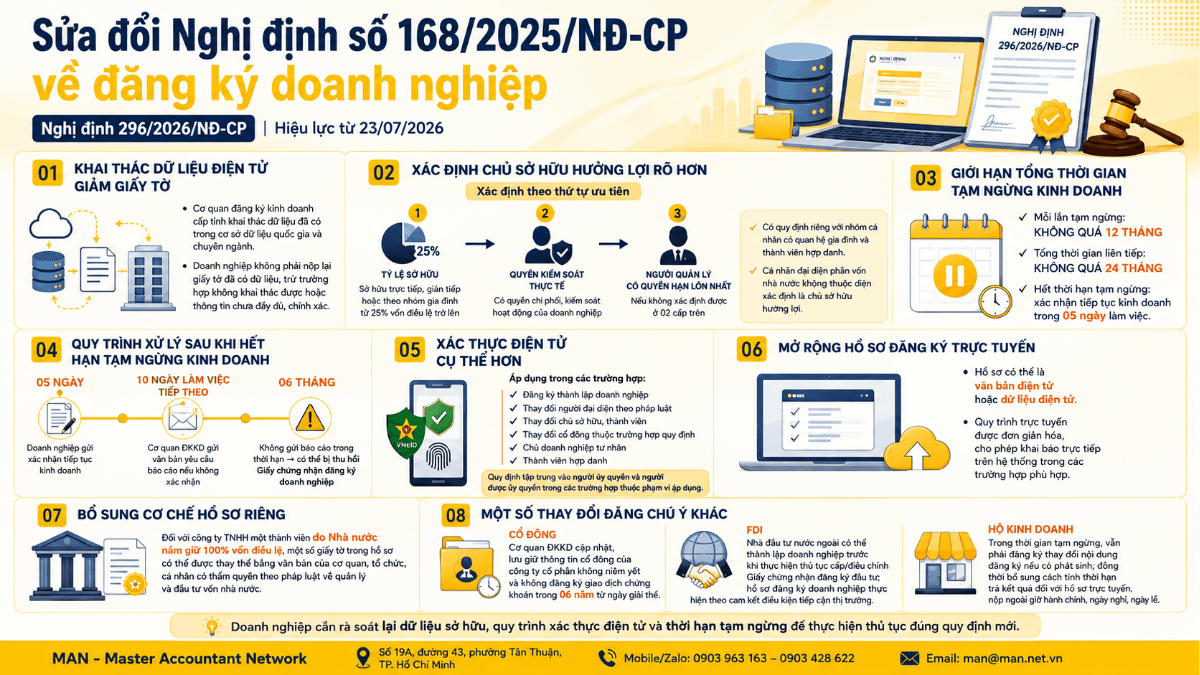
Decree No. 296/2026/ND-CP adds many completely new principles, tasks, and procedures to Decree No. 168/2025/ND-CP, effective from July 23, 2026.
Provincial-level business registration agencies are responsible for proactively accessing and utilizing information already available in the national database and specialized databases. Businesses are not required to resubmit copies of documents already in the database, such as the Business Registration Certificate or Investment Registration Certificate; only in cases where the information cannot be accessed, or is incomplete or inaccurate, will the business registration agency request copies to complete the application.
The new additions include:
- Reusing electronic data: Provincial business registration agencies utilize integrated information from the National Business Registration Database with other national and specialized databases (Clause 7, Article 4).
- The documentation mechanism for a State-owned limited liability company with a registered capital of 100%: Allows the use of documents issued by competent authorities under the law on state capital management to replace some documents in the business registration dossier (Clause 8, Article 4).
- Storing shareholder information for joint-stock companies: The business registration authority is assigned the additional task of updating and retaining information on shareholders of unlisted and unregistered joint-stock companies for a period of 6 years from the date of the company's dissolution (Clause 8a, Article 21).
- Establishing an FDI enterprise before carrying out the procedures for issuing or amending the Investment Registration Certificate: In cases where foreign investors establish a business before carrying out the procedures for granting or amending the Investment Registration Certificate, the business registration dossier does not include a copy of the Investment Registration Certificate but must be accompanied by a commitment to meet the market access conditions (Clause 6, Article 24).
- Obligation to register changes during a period of temporary suspension of operations: Businesses and household businesses that are temporarily suspending operations must still register changes or notify changes to their registration if any arise (Clause 7, Article 60; Clause 3, Article 61; Clause 5, Article 103).
- Procedures for confirming continued business operations and handling violations: Within 5 working days after the temporary suspension of business expires, the enterprise must submit a written confirmation of resuming business operations. If the enterprise fails to submit the confirmation, within the next 10 working days, the business registration authority will send a written request for a report. If the enterprise fails to submit the report within 6 months from the deadline for submitting the report, the business registration authority will then revoke the Business Registration Certificate (Clause 8, Article 60).
- Processing time for online business registration applications: Add detailed regulations on how to calculate the time limit for returning results for applications submitted after business hours, on weekends or holidays (Clause 4, Article 112).
Significant revisions to business procedures and obligations.
Decree No. 296/2026/ND-CP directly amends many provisions in Decree No. 168/2025/ND-CP to standardize the components of application dossiers, verification procedures, and information transparency obligations.
Here's a detailed summary of the revisions between the two texts:
| Center | Regulations stipulated in Decree 168/2025/ND-CP | Regulations amended in Decree 296/2026/ND-CP | Amendments |
|---|---|---|---|
| Contributing capital to businesses | The regulations only stipulate that the founder shall self-declare and be responsible for the legality, truthfulness, and accuracy of the declared information (Clause 1, Article 4). | A mandatory regulation has been added: Owners, shareholders, and members of a company are prohibited from using someone else's name to contribute capital to the business. | Article 1, paragraph 1 |
| Electronic authentication | The authorizing party and the authorized party are required to jointly authenticate electronically when carrying out the procedure (Clause 5, Article 12). | The regulations specify the cases requiring electronic authentication: registration of establishment, change of legal representative, owner, members of limited liability companies, founding shareholders, foreign investor shareholders (of unlisted and unregistered joint-stock companies), private enterprise owners, and general partners. | Article 2 |
| Identify the Beneficiary | The simple definition is based on the direct/indirect ownership ratio from 25% capital or controlling rights (Article 17). | Detailed definition in order of priority: 1. Ownership ratio (direct/indirect/family group) $\rightarrow$ 2. Actual control $\rightarrow$ 3. Top manager. Excludes representatives of state capital. | Article 3 |
| Declaration of Beneficiary Owner | Declare cases where shareholders/members own 25% or more of the capital or are owners of a single-member limited liability company (Article 18). | The regulations stipulate a mandatory declaration review process based on three priority levels (ownership ratio $\rightarrow$ actual control $\rightarrow$ highest-ranking manager). Businesses are responsible for self-reviewing each level. | Article 4 |
| Business suspension period | Each suspension notice shall not exceed 12 months, with no provision for the total consecutive suspension period (Clause 1, Article 60). | Maintain the regulation that each temporary suspension of business must not exceed 12 months, while adding a limit: The total consecutive period of business suspension must not exceed 24 months. | Article 11, paragraph 1 |
| Document translation | Requires a "notarized Vietnamese translation" for foreign-language documents in the application file (Clause 2, Article 10). | Replace this with the requirement "Vietnamese translation certified with the translator's signature". | Article 19, paragraph 1 |
| Processing time for certain procedures | The processing time for certain procedures, such as suspending a procedure, reissuing a document, or correcting information, is 3 working days. | Reduce the processing time for the above procedures to 2 working days. | Article 19, paragraph 3 |
| Company dissolution documents | The required documents are specified in Clause 1, Article 210 of the Enterprise Law (Clause 3, Article 64). | In addition to the required submission, a copy of the shareholder register must be provided for joint-stock companies that are not listed on the stock exchange and not registered for securities trading. | Article 13 |
| Online registration form | The regulations stipulate that online registration documents are "electronic documents" (Clause 1, Article 38; Clause 1, Article 112). | Expand the types of documents that can be submitted to include "electronic documents or data" entered directly into the system, without requiring the uploading of attached files. | Articles 8 and 17 |
Furthermore, the online business registration process has been simplified. Authorized signatories no longer need to resubmit completed forms directly on the system and can log in for authentication through the National Public Service Portal or the VNeID application.
These regulations will be repealed from July 23, 2026.
According to Article 19 of Decree No. 296/2026/ND-CP, some provisions of Decree No. 168/2025/ND-CP officially cease to be in effect:
- Article 37: General provisions regarding online business registration.
- Paragraph 2 of Article 52: Regulations regarding notification of changes in shareholder information for organizations owning 25% or more of the total voting shares.
- Article 111: General provisions for online business registration.
- Paragraph 3 of Article 124: Amendments to Decree No. 31/2021/ND-CP.
- Remove certain phrases such as "and list of authorized representatives" in Clause 3 of Article 54, and "place where the application was submitted" in Clause 5 of Article 95 to ensure clarity and consistency in the document.
Expert perspective from MAN – Master Accountant Network
Expert analysis from MAN – Master Accountant Network indicates that Decree No. 296/2026/ND-CP places higher demands on the self-discipline, transparency, and accuracy of data declared by businesses.
To ensure full compliance with the new regulations and avoid potential legal risks, businesses should take the following steps:
- Review the capital structure and terminate the practice of indirect ownership: Adding the prohibition against "using someone else's name to contribute capital" requires businesses to review their existing member/shareholder lists to verify the information of the true owners.
- Determine the Beneficiary Owners according to the three levels: Businesses must proactively create a diagram identifying the beneficial owners in the following order: Ownership percentage (direct, indirect, combined family group) $\rightarrow$ Actual control $\rightarrow$ Top manager. Businesses need to keep records proving the basis for this determination at their headquarters.
- Strictly manage the duration of business suspensions: It should be noted that the total consecutive suspension period must not exceed 24 months. Upon expiration of the suspension, the business must send confirmation within 5 working days to avoid falling into the 10-day violation processing period.