



Professional license: CPA Vietnam Auditors
Experience: Over 30 years of experience in Accounting, Auditing, and Financial Consulting.
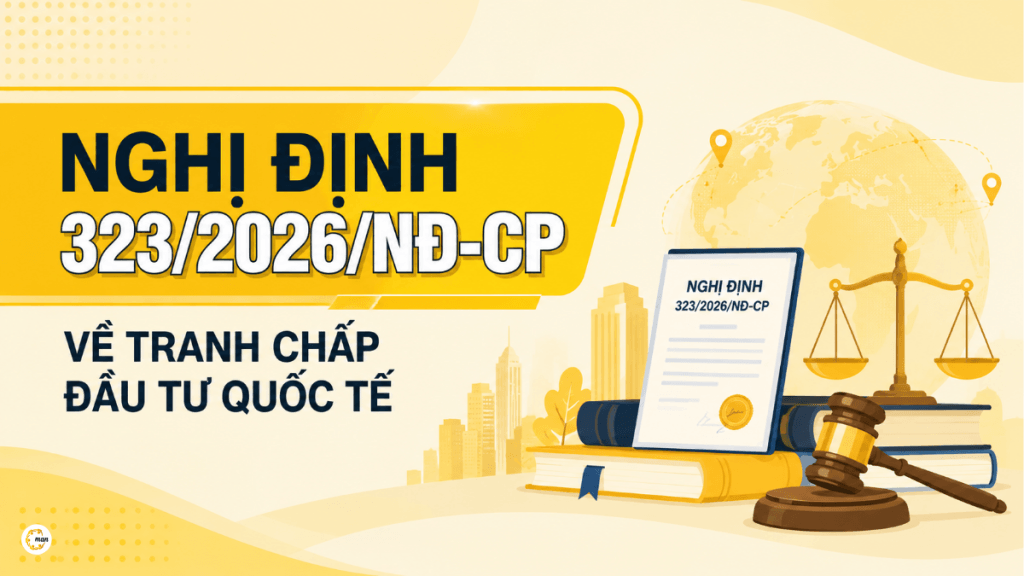
On August 17, 2026, the Government issued Decree 323/2026/ND-CP This document details certain provisions and implementation measures of Resolution No. 20/2026/QH16 on the prevention and resolution of international investment disputes. Effective immediately from the date of signing, the document focuses on improving inter-agency coordination mechanisms, establishing strict time limits for litigation proceedings, and setting specific policies for dispute prevention and resolution.
Timelines for resolving international investment disputes
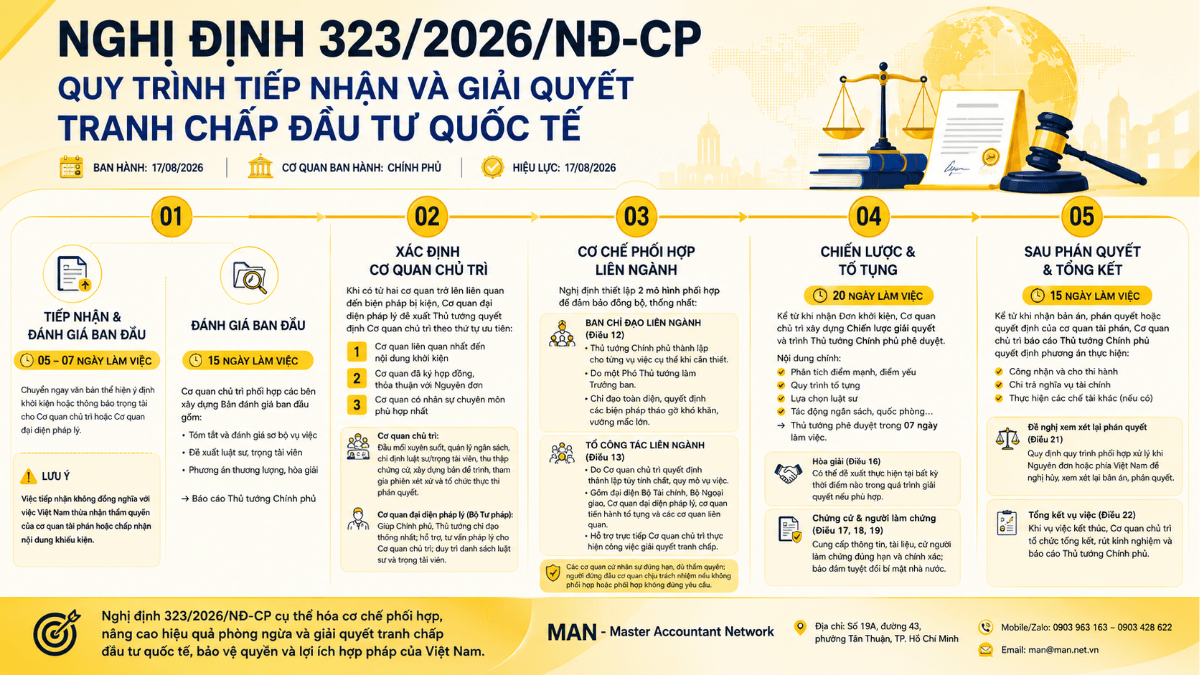
Decree 323/2026/ND-CP stipulates deadlines ranging from 5 to 20 working days depending on the processing stage, notably including 15 days for developing the initial assessment report and 20 days for developing the case resolution strategy. This strict timeframe applies uniformly to all relevant agencies in the litigation process.
Below is a detailed summary of the procedural deadlines stipulated in Articles 8, 14, 15, and 20 of Decree 323/2026/ND-CP:
| Litigation phase | Deadline | Responsible agency | Specific job duties |
|---|---|---|---|
| Notification when the lead agency receives the document. | 05 working days from the date of receipt | Lead agency | Provide written notification to the Legal Representative (Ministry of Justice) upon receipt of a document expressing the intention to initiate legal proceedings or a notice of arbitration. |
| Transfer the document when another agency receives it. | 05 working days from the date of receipt | The agency is not the lead agency. | Forward all received documents to the Lead Agency or the Legal Representative Agency (if the Lead Agency has not yet been identified). |
| Processing documents at the Legal Representative Office | 7 working days from the date of receipt of complete documents. | Legal representative agency (Ministry of Justice) | Forward the document to the Lead Agency (if already identified); or report to the Prime Minister for a decision on the Lead Agency (if identification is necessary). |
| Develop an Initial Assessment Report | 15 working days from the date of receipt of the written intent to initiate litigation or the notice of arbitration. | The lead agency will coordinate with the parties involved. | Summarize the case, provide a preliminary assessment, propose the use of legal counsel, appoint arbitrators, and suggest a negotiation and mediation plan, and report to the Prime Minister. |
| Develop a case resolution strategy. | 20 working days from the date of receipt of the Complaint. | The lead agency will coordinate with the parties involved. | Analyze the strengths, weaknesses, and budget impact, and submit it to the Prime Minister for approval (the Prime Minister approves within 7 working days). |
| Report on the plan for implementing the ruling. | 15 working days from the date of receiving the judgment, ruling, or decision of the judicial body. | The lead agency will coordinate with the parties involved. | The report is submitted to the Prime Minister for a decision on the implementation plan, including the plan for paying financial obligations or enforcing sanctions. |
Following the issuance of the ruling, the authorities will continue to manage the process in accordance with the following regulations:
- Enforcement of judgments and financial obligations: In cases where the ruling determines that Vietnam has financial obligations, the lead agency shall coordinate with the corresponding financial agency to develop a payment plan and submit it to the competent authority for approval in accordance with Article 20.
- Procedures for handling requests for review: According to Article 21, in cases where an annulment or review of a judgment is requested, the lead agency shall notify the legal representative agency (Ministry of Justice) within 3 working days to propose a course of action and report it to the Prime Minister.
Mechanism for dispute prevention and handling of complaints through the National Information Portal.
According to Article 6 of Decree 323/2026/ND-CP, foreign investors have the right to submit feedback and suggestions to National Investment Portal To resolve any arising issues, the Portal Management Agency is responsible for forwarding the dossier to the competent authority within 5 working days, and the resolving agency must process and update the results within 30 working days.
The process of receiving and preventing disputes through the National Investment Portal is carried out in the following order:
- Receiving and transferring documents: Within the timeframe 05 working days Upon receiving feedback and suggestions, the National Investment Portal Management Agency (under the Ministry of Finance) forwards the files to the competent authority for processing, and simultaneously notifies the legal representative agency (Ministry of Justice) and the local investment management agency for coordinated monitoring.
- Processing time and results update: Within 30 working days From the date of receiving the application, the processing agency is responsible for handling it and updating the results on the National Investment Information Portal.
- Assess the risks and report to the Prime Minister: If there are insufficient grounds for resolution, or if the case shows signs of violating commitments and risks giving rise to international disputes, the resolving agency shall report to the Prime Minister within the specified timeframe. 10 working days since receiving feedback from all ministries and departments.
In addition to the feedback reception process, Article 5 of Decree 323/2026/ND-CP sets out the following principles for investment promotion activities:
- No commitment exceeding authority: State agencies and state-owned enterprises are prohibited from arbitrarily committing to or including in cooperation agreements preferential mechanisms and policies that exceed their authority or are not stipulated in current legal documents, such as: Investment Law 2025.
- Legal validity of promotional materials: Information and promotional materials used in investment promotion activities are for reference only, do not replace administrative decisions, and do not constitute legally binding commitments of the State to foreign investors.
Assignment of responsibilities and two models of inter-sectoral coordination.
Decree 323/2026/ND-CP clearly defines the roles between the Legal Representative Agency (Ministry of Justice) and the Lead Agency in each case, and establishes two coordination models: the Inter-Ministerial Steering Committee and the Inter-Ministerial Working Group. This strict assignment of responsibilities ensures consistency and professionalism throughout the litigation process.
The division of responsibilities among the agencies is implemented as follows:
- Identify the Lead Agency: According to Article 9, in cases involving multiple agencies, the Ministry of Justice proposes that the Prime Minister decide on the lead agency based on the following order of priority: the agency with the most relevant measures to the subject matter of the lawsuit, the agency that has signed a contract/agreement with the Plaintiff, or the agency with the most suitable professional personnel. If the relevant agency is a prosecuting authority, the selection of the lead agency is based on the most relevant functions and responsibilities and the availability of suitable personnel.
- Responsibilities of the Legal Representative Office: According to Article 11, the Ministry of Justice is the focal point assisting the Government in providing unified direction and legal advice to the lead agency throughout the litigation process, while also maintaining the list of arbitrators and lawyers.
- Principles for receiving documents: Article 8 affirms that the receipt and processing by a state agency of a document expressing an intention to initiate legal proceedings or a notice of arbitration does not equate to Vietnam recognizing the jurisdiction of the judicial body or accepting the content of the complaint.
To focus resources on handling the case, the Decree specifies the structure of the two inter-agency coordination models as follows:
- Inter-ministerial Steering Committee (Article 12): The Prime Minister decides to establish a Steering Committee for each specific case as needed. The Head of the Steering Committee is the Deputy Prime Minister in charge of the relevant field, the Deputy Head is the Head of the lead agency, and the members include representatives from relevant ministries and agencies to provide comprehensive direction.
- Inter-agency working group (Article 13): The team is established by the lead agency. The team leader is the head of the lead agency; the deputy team leaders include representatives from the Ministry of Finance, the legal representative agency (Ministry of Justice), and the prosecuting authority whose measures are being challenged (if any). Members include representatives from the Ministry of Finance, the Ministry of Foreign Affairs, the legal representative agency, and other relevant agencies.
Specialized financial policies and personnel support schemes.
Decree 323/2026/ND-CP stipulates that the state budget will ensure all funding for the prevention and resolution of international investment disputes, and will also apply a policy of financial support for officials and civil servants directly involved in handling these cases. Actual expenses incurred during the litigation process will be reimbursed based on valid documentation.
The specific expenditure levels and financial support policies are as follows:
- Payment will be based on actual costs incurred: According to Article 24, expenses for lawyer fees, expert consultation fees, judicial proceedings fees, data acquisition costs, and compensation for lost witness days shall be paid based on actual contracts and valid documentation.
- Job position support for dispute prevention and resolution: Officials working in positions related to the prevention and resolution of international investment disputes at ministries, departments, and localities receive a monthly allowance. 100% Salary based on current salary coefficient (excluding allowances).
- Provide personnel directly involved in resolving the incident: Individuals directly involved in resolving cases at the lead agency and the legal representative agency (Ministry of Justice) receive a monthly allowance. 300% Salary based on the current salary coefficient during the period of direct participation in litigation.
- Support for members of the Inter-agency Task Force: Officials participating in the inter-agency task force receive an additional monthly allowance equal to... 100% Salary based on current salary coefficient.
The period for receiving support benefits is determined specifically as follows:
- Start time: This is calculated from the month the arbitration panel is established or when the competent court issues a notice of acceptance of the case (or equivalent document).
- End time: This is calculated up to the month the judicial body issues the final judgment, ruling, or decision concluding the case.
Transitional provisions and effective date
Decree 323/2026/ND-CP takes effect from the date 17/8/2026, and also stipulates a transitional mechanism applicable to cases arising before the date of issuance.
Based on Article 27, the transitional provisions apply to the following specific cases:
- Forward the case file: Disputes arising before the date 01/5/2026 Cases that have not yet received a final judgment will continue to be resolved according to the provisions of this Decree. Complaints, suggestions, or written intentions to sue submitted before August 17, 2026, that are currently being processed will also be subject to the new procedure.
- Time of calculation of funding and support: Funding for task implementation and monthly allowances for officials involved in dispute resolution under the Decree shall be calculated and disbursed from the date of issuance. 01/5/2026.
A business perspective from MAN.
From a professional perspective MAN – Master Accountant Network, Decree 323/2026/ND-CP establishes a rigorous and transparent litigation management process. To proactively prevent legal risks and effectively coordinate with regulatory agencies, business owners, CEOs, CFOs, and legal teams can take note of the following points:
- Review the legal validity of agreements and commitments: Businesses should note that information promoting investment or commitments to incentives that exceed their authority does not constitute a legally binding obligation of the State. Investors and FDI enterprises Therefore, the project approval document should be carefully reviewed., Investment Registration Certificate (IRC) and project contracts to ensure incentives are granted by the proper authority.
- Use the National Investment Portal correctly: When administrative issues arise, businesses can submit feedback and suggestions through the National Investment Portal. Knowing the 30-working-day processing deadline allows businesses to proactively monitor the progress of resolution by the competent authorities.
- Prepare a transparent and complete set of evidence: The decree allows for proposals to conduct mediation at any point during the dispute resolution process if deemed appropriate. Businesses need to maintain complete and systematized records of all accounting documents and financial vouchers. project legal documents From the outset, to serve as a basis for consultations or mediation when necessary.
Conclude
Decree 323/2026/ND-CP is an important legal document that concretizes the inter-agency coordination mechanism and procedures for preventing and resolving international investment disputes. Understanding the procedural timelines, complaint handling procedures, and principles limiting the scope of committed jurisdiction will help agencies, organizations, and businesses proactively comply with the law and protect their legitimate rights.