





Professional license: CPA Vietnam Auditors
Experience: Over 30 years of experience in Accounting, Auditing, and Financial Consulting.
The obligation to contribute capital on time is one of the core legal requirements for foreign individuals and organizations participating in direct or indirect investment activities in Vietnam. In practice, the deadline for foreign investors to contribute capital is not fixed at 90 days for all cases, but depends on the form of investment: contributing capital to establish a new economic organization (under ERC), implementing an investment project (under IRC), or capital contribution transactions, share purchases, or equity purchases (M&A).
The interpretation of applying a general 90-day timeframe to all cases does not fully reflect current legal regulations. The deadline for foreign investors to contribute capital varies depending on the form of investment: contributing capital to establish a new economic organization, implementing an investment project according to an investment registration certificate, or conducting transactions involving capital contributions, share purchases, or acquisition of capital stakes in existing businesses.
How long must foreign investors contribute capital?
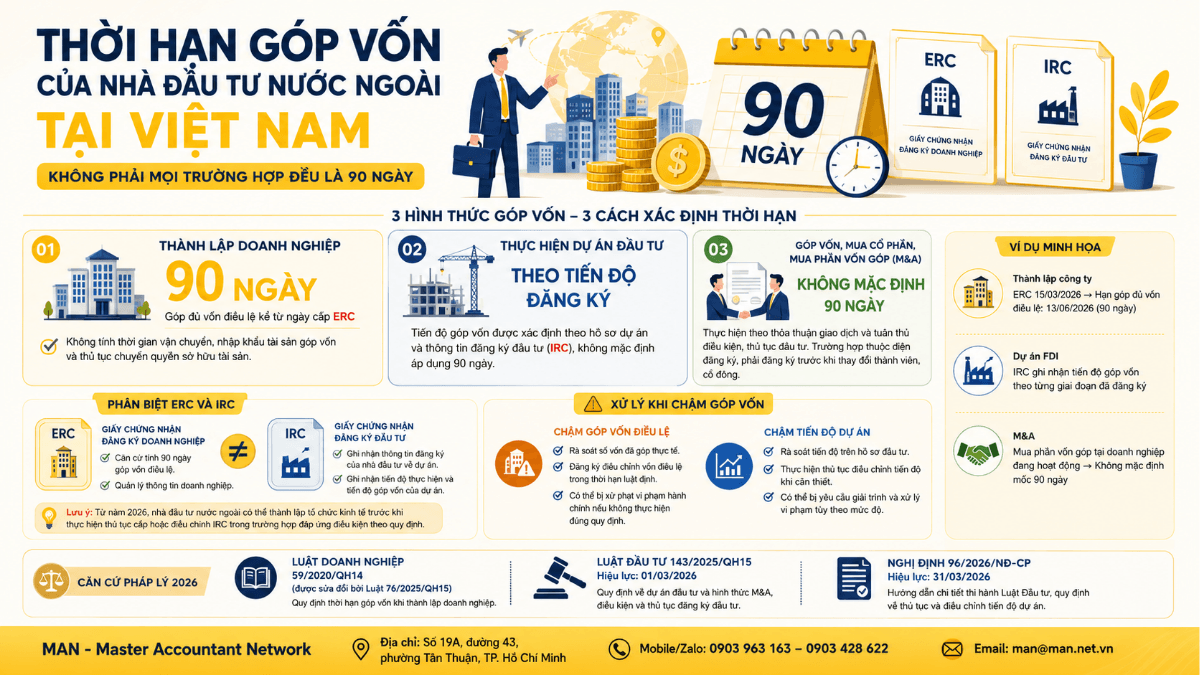
The deadline for foreign investors to contribute capital is not fixed for all cases. The 90-day deadline applies to capital contributions for the establishment of a business, calculated from the date of issuance of the Enterprise Registration Certificate (ERC). For capital used in investment projects, the deadline is determined according to the progress schedule stated in the project documentation.Investment Registration Certificate (IRC). The timing and method of payment in M&A transactions are determined by the transaction agreement and relevant legal regulations; however, in cases subject to registration under the Investment Law, investors must complete the registration procedures before changing members or shareholders.
Vietnamese law clearly defines capital contribution obligations into three main groups to ensure transparency in the management of foreign exchange flows and project implementation progress, including the following specific forms:
- Contributing capital to establish a business: Subject to the direct regulation of the Enterprise Law No. 59/2020/QH14 (amended and supplemented by Law No. 76/2025/QH15).
- Contributing capital to implement investment projects: Follow the committed schedule at project profile and Investment Registration Certificate (IRC) under Investment Law No. 143/2025/QH15 and Decree No. 96/2026/ND-CP.
- Mergers and Acquisitions (M&A): Based on the transaction contract, market access conditions, and investment registration procedures as stipulated.
Legal framework for foreign investment to be in effect from 2026.
The legal framework governing foreign investment activities applies the following important legal documents:
- Law on Investment No. 143/2025/QH15 (effective from March 1, 2026): This serves as the primary legal basis, effective from March 1, 2026, standardizing the process for reviewing and approving investment policies, registering capital contributions for share purchases, and monitoring the progress of capital contributions in FDI projects.
- Decree No. 96/2026/ND-CP (effective from March 31, 2026): Detailed guidelines for implementing the Investment Law clearly stipulate the authority, documentation, and procedures for adjusting the implementation schedule of investment projects in cases where adjustments to the capital contribution schedule arise.
- The Enterprise Law was amended by Law No. 76/2025/QH15: The regulations on contributing charter capital are applied according to the amended and supplemented Enterprise Law.
90-day deadline for contributing capital to establish a business.
When establishing a foreign-invested enterprise in Vietnam, the owner, members, or shareholders have a maximum of 90 days to fulfill their obligation to contribute the full registered charter capital. This timeframe is calculated precisely from the date the enterprise is granted its Enterprise Registration Certificate (ERC), excluding the time for transporting, importing contributed assets, and completing asset ownership transfer procedures.
According to regulations effective from 2026, foreign investors can establish economic organizations before implementation. investment registration procedures Issuing and amending Investment Registration Certificates in cases where the conditions are met as prescribed. Therefore, the timing of issuing ERCs and IRCs does not always follow a single sequence.
The obligation to contribute capital to establish a company is tracked through the following basic steps:
- Commencement of military service: The timeframe is calculated starting from the date the Enterprise Registration Certificate (ERC) is issued.
- Capital contribution completed: Investors must contribute the full amount of capital in accordance with the type of assets and within the timeframe stipulated by law.
- What to do if you lack capital: The company must complete the procedure for registering a reduction in charter capital within the following 30 days.
Contributing capital to establish a limited liability company with two or more members.
According to the Enterprise Law No. 59/2020/QH14, members (including foreign investors) must contribute capital to the company in full and with the correct type of assets as committed within 90 days from the date of issuance of the Business Registration Certificate.
The time spent on transporting and importing contributed assets, and completing administrative procedures to transfer ownership of assets, is not included in this 90-day period. During this period, members have rights and obligations corresponding to their committed capital contribution ratio.
Contributing capital to establish a single-member limited liability company.
The company owner (in the case of a foreign investor) must contribute the full amount and the correct type of assets as committed when registering the business within 90 days from the date of issuance of the Business Registration Certificate.
If the registered capital is not fully contributed within the prescribed time limit, the company owner must register a change in registered capital to the value of the contributed capital within 30 days from the last day on which the full registered capital should have been contributed.
Payment of share dividends upon establishment of a joint-stock company.
Shareholders (including foreign investors) must pay the full amount of the shares they have subscribed for within 90 days from the date the company is granted its Certificate of Business Registration, unless the company's charter or the share subscription agreement stipulates a different, shorter period.
In the event that a shareholder fails to pay or only partially pays for the shares they have registered to purchase, the matter will be handled according to the provisions of the Enterprise Law, and the unpaid shares will be offered for sale at the decision of the Board of Directors.
What should members and shareholders be aware of regarding charter capital?
When managing registered capital flows, businesses and investors need to clearly distinguish between the following key legal concepts:
- Registered capital: This is the total value of assets contributed or pledged by members when establishing a limited liability company, or the total par value of shares sold or subscribed for when establishing a joint-stock company.
- Committed capital contribution: The specific amount of capital each member/shareholder registers to contribute to the business determines their ownership percentage and corresponding limited liability.
- Regulations regarding cashless payments: The transfer of capital contributions and the purchase of equity stakes must comply with the applicable payment methods and foreign exchange management regulations for each type of investment.
Deadline for capital contribution to implement investment project
The deadline for capital contribution to implement an investment project is determined according to the capital contribution schedule stated on the Investment Registration Certificate (IRC) or the investment project registration dossier. This schedule can extend over each phase of the project's implementation and is not subject to the mandatory 90-day limit like charter capital. To learn more about the legal role of this document, you can refer to the detailed article on... The concept of an Investment Registration Certificate (IRC).
The project's capital contribution schedule is determined according to the investment dossier.
When registering an investment project in Vietnam, investors must declare in detail the components of the total investment capital, including the following items:
- Investor's capital contribution: The investor's own capital is committed to contributing funds to implement the project.
- Capital raised: Loan capital can be obtained from credit institutions, parent companies, or other legitimate sources.
- Progress of capital contribution and fundraising: The detailed disbursement schedule for each stage is recorded in the investment dossier and the Investment Registration Certificate (IRC) in accordance with Investment Law No. 143/2025/QH15.
Distinguish between registered capital and investment capital of a project.
The differences between the two types of capital are illustrated in the comparison table below:
| Criteria | Registered capital | Project investment capital |
|---|---|---|
| Legal nature | Capital committed by members/shareholders to establish an economic organization. | Total capital required to implement all project activities. |
| Record | Enterprise Registration Certificate (ERC), Articles of Association. | Investment Registration Certificate (IRC), Decision approving the investment policy. |
| Based on the deadline | Law on Enterprises No. 59/2020/QH14 (amended by Law No. 76/2025/QH15). | Project progress is recorded on the IRC in accordance with Investment Law No. 143/2025/QH15. |
| 90-day milestone | This is mandatory from the date of issuance of the ERC. | No defaults apply; implementation will follow the project's committed schedule. |
This clear separation helps businesses effectively manage two independent timelines under ERC and IRC licenses.
When the actual capital contribution schedule differs from the investment plan.
In the event that the capital contribution schedule recorded on the IRC cannot be met due to objective reasons or changes in the business plan, the investor needs to review the feasibility and carry out the procedure for adjusting the project schedule as stipulated in the Investment Law No. 143/2025/QH15 and Decree No. 96/2026/ND-CP. If the adjustment process or processing time is unclear, the investor can review the relevant procedures. Time and cost of carrying out the IRC procedure To proactively plan the implementation.
Deadline for foreign investors to contribute capital, purchase shares, or acquire equity stakes.
The deadline for capital contribution in M&A (capital contribution, share purchase, or acquisition of equity in an existing economic entity) is not automatically bound by the 90-day deadline for business establishment. The payment deadline is determined by the transaction agreement and must comply with the investment conditions and procedures applicable to the transaction.
Contributing capital to an existing economic organization.
In the case of a foreign investor contributing additional capital to an existing enterprise in Vietnam to increase its charter capital, the deadline for capital contribution shall be in accordance with the Resolution/Decision of the Board of Members or the General Meeting of Shareholders of that enterprise, consistent with the capital contribution approval of the Investment Registration Authority if registration is required.
Buying shares of a joint-stock company
The repurchase of shares from existing shareholders is governed by the share purchase agreement. The payment deadline for the shares is agreed upon by the parties in the agreement, and the transfer of payment must comply with the State Bank of Vietnam's foreign exchange management regulations.
Purchasing equity stakes in a limited liability company.
When acquiring a stake in a limited liability company, the foreign investor completes the payment within the timeframe committed in the transfer contract. After the transaction is completed, the enterprise is responsible for registering the change of members within 10 days from the date of completion of the transfer, as stipulated by the Enterprise Law.
In cases where registration is required before changing members or shareholders...
According to Article 21 of the Investment Law No. 143/2025/QH15, foreign investors must complete the procedures for registering capital contributions, share purchases, and equity purchases, and receive notification of fulfillment of conditions from the Investment Registration Authority before carrying out procedures for changing members or shareholders if they fall under the following cases:
- Contributing capital or purchasing shares increases the ownership percentage of foreign investors in economic organizations operating in sectors or professions subject to conditional market access.
- Capital contributions and share purchases resulting in foreign investors holding more than 50% of the charter capital or increasing their ownership stake in the charter capital of an economic organization after already holding more than 50% of the charter capital.
- Foreign investors making investments related to economic organizations that have land use rights in islands, border communes, wards, towns, coastal areas, or other areas affecting national defense and security.
How to handle delays in capital contributions from foreign investors?
When a delay in capital contribution occurs, the first step is to identify the type of capital that is delayed: charter capital or project implementation capital.
Delay in contributing charter capital
If, after 90 days from the date of issuance of the ERC, the member/shareholder has not completed the capital contribution, the corresponding procedures include:
- Limited Liability Company: Within 30 days from the deadline for full capital contribution, the company must register an adjustment to its charter capital to reflect the actual contributed capital. Members who have not fully contributed their capital shall be liable for the company's financial obligations arising before the change, corresponding to the amount of capital they committed to.
- Joint Stock Company: The company must register an adjustment to its charter capital equal to the par value of the fully paid shares within 30 days from the end of the share payment period.
In cases where capital adjustments are not made within the prescribed timeframe, businesses will be subject to administrative penalties as stipulated in Decree 122/2021/ND-CP (amended and supplemented by Decree 288/2026/ND-CP) in the field of planning and investment.
Delays in project capital contribution.
Delays in capital contribution for project implementation that do not go through the adjustment procedure may give rise to obligations to adjust investment dossiers, require explanations, and risk administrative penalties depending on the case. For serious violations or those falling under legal grounds, the investment management agency will consider more severe penalties as stipulated in the Investment Law.
Common misconceptions regarding FDI capital contribution deadlines.
Many legal risks arise from investors and businesses incorrectly applying legal regulations:
- Assuming all foreign investors are required to contribute capital within 90 days: The 90-day deadline only applies to the obligation to contribute charter capital when establishing a new business. M&A or capital contributions based on project progress have their own timeframes.
- The misconception that the 90-day period is calculated from the date the IRC is issued: The 90-day deadline for contributing charter capital is calculated precisely from the date of issuance of the Enterprise Registration Certificate (ERC). The IRC records the investor's registration information regarding the project, including the implementation progress and capital contribution schedule as per the investment dossier.
- Determine that the registered capital and the project investment capital are the same: Charter capital is recorded on the ERC in accordance with the Enterprise Law. Project investment capital, including both contributed capital and raised capital, is recorded on the IRC in accordance with the Investment Law.
- Confusion regarding the deadline for M&A capital contributions: The payment terms in M&A transactions depend on the contractual agreement and the fulfillment of investment conditions, and are not automatically bound by a 90-day deadline.
For example, determining the deadline for capital contribution by foreign investors.
The following real-world scenarios illustrate in detail how to apply timelines to each type of investment:
Case 1 – Establishing a Limited Liability Company
Investor A (a Singaporean national) was granted an Investment Registration Certificate (IRC) on January 10, 2026, and subsequently received an Enterprise Registration Certificate (ERC) to establish Company B Limited in Ho Chi Minh City on March 15, 2026, with a registered capital of VND 2 billion. In this scenario, the 90-day deadline for contributing the registered capital is calculated precisely from the date of issuance of the ERC (March 15, 2026), determining the final deadline for members to complete the contribution of VND 2 billion as June 13, 2026. If by June 13, 2026, the members have only contributed VND 1.5 billion, Company B is obligated to register a reduction in registered capital to VND 1.5 billion within the next 30 days (no later than July 13, 2026).
Case 2 – Establishing a joint-stock company
Two foreign investors jointly established Company C and were granted a Business Registration Certificate on April 1, 2026. According to regulations, shareholders are obligated to pay the full amount of the registered shares within 90 days from the date of issuance of the ERC, corresponding to a deadline of June 30, 2026. If the full amount of registered shares is not paid by June 30, 2026, the company is responsible for registering an adjustment to its charter capital to the par value of the paid shares within the following 30 days.
Case 3 – Mergers and Acquisitions (M&A)
Investor D acquired 40% of the capital contribution in Company E, a currently operating limited liability company. After the Investment Registration Authority notified that the conditions for capital contribution, share purchase, and capital contribution acquisition were met on May 10, 2026, both parties proceeded with the procedures as agreed upon in the transaction agreement, stipulating payment in two installments within 60 days. This transaction does not apply the 90-day deadline for business establishment. Investor D made payments for the capital contribution according to the schedule committed in the transaction contract, and Company E is responsible for completing the registration of the change of members within 10 days from the date of completion of the transfer.
Case 4 – FDI projects with capital contribution schedules
The FDI F Company's factory project has a total investment of US$10 million, of which US$3 million is committed by the investor. The Investment Registration Certificate (IRC) issued on April 10, 2026, specifies the capital contribution schedule: Phase 1 (US$1 million) to be contributed within 3 months and Phase 2 (US$2 million) to be contributed within 12 months from the date of IRC issuance. Accordingly, the investor is obligated to complete Phase 1 before July 10, 2026, and Phase 2 before April 10, 2027. This schedule is determined according to the capital contribution and mobilization schedule recorded in the investment dossier and IRC, separate from the obligation to contribute charter capital as stated in the ERC.
Legal basis regarding the deadline for foreign investors to contribute capital.
Current legal documents regulating capital contribution obligations include:
- Law on Enterprises No. 59/2020/QH14: The regulations specify a 90-day deadline for contributing charter capital for various types of businesses.
- Law No. 76/2025/QH15: Amendments and additions to certain articles of the Enterprise Law.
- Investment Law No. 143/2025/QH15: Effective from March 1, 2026, the regulations stipulate the legal framework for M&A projects and forms.
- Decree No. 96/2026/ND-CP: Effective from March 31, 2026, detailed guidance on the implementation of certain provisions of the Investment Law.
Conclude
Here are three key points regarding the deadline for foreign investors to contribute capital:
- Mold 90 days This is the mandatory deadline for making the full contribution. charter capital calculated from the date of issue ERC According to the Enterprise Law.
- Contribution progress investment capital of the project determined flexibly according to each stage recorded in the investment dossier and IRC According to the Investment Law.
- Work Mergers and Acquisitions (M&A) The transaction must be carried out in accordance with the contract and must meet the registration conditions and procedures as prescribed.
Understanding the differences between ERC and IRC is key to effectively managing FDI flows in Vietnam. FDI enterprises and foreign investors preparing to make capital contributions or needing to adjust investment schedules should proactively review their legal documents. Our team of investment legal experts at [Company Name] MAN – Master Accountant Network We are always ready to assist and advise on the most optimal compliance solutions.
Frequently Asked Questions about the Capital Contribution Deadline for Foreign Investors
How long must foreign investors contribute capital?
The deadline for capital contribution depends on the form of investment. If contributing capital to establish a company, the deadline for contributing charter capital is 90 days from the date of issuance of the ERC. If contributing capital for a project, the deadline is based on the progress stated in the project dossier/IRC.
From what date is the 90-day capital contribution period calculated?
The 90-day period for contributing charter capital is calculated from the date the enterprise is granted its Enterprise Registration Certificate (ERC), excluding the time for transporting, importing assets, and completing procedures for transferring ownership of assets.
Do foreign investors who purchase equity have to contribute capital within 90 days?
Not mandatory. The payment deadline for the purchase of equity stakes is determined by agreement in the transfer contract and investment law regulations, and is not automatically bound by the 90-day deadline for business establishment.