




Whether foreigners can register a sole proprietorship under their own name is a crucial legal question for investors wishing to establish small-scale businesses in Vietnam. According to Article 80 of Decree 01/2021/ND-CP on business registration, the right to establish a sole proprietorship is currently limited to Vietnamese citizens and members of Vietnamese households with full legal capacity. This confirms that foreign individuals cannot directly register a sole proprietorship under their own name. To comply with legal regulations and ensure ownership rights, investors should consider foreign direct investment (FDI) business models under the 2020 Investment Law.
Can foreigners register a household business?
Current legal regulations in Vietnam provide very specific guidelines to distinguish between domestic household businesses and foreign-invested activities. Understanding these regulations helps foreign individuals avoid legal risks when starting a business. Many investors still wonder whether foreigners can register a household business under their name to open a cafe or small shop, but in reality, this regulation is quite strict.
Regulations in Decree 01/2021/ND-CP on foreigners registering business households.
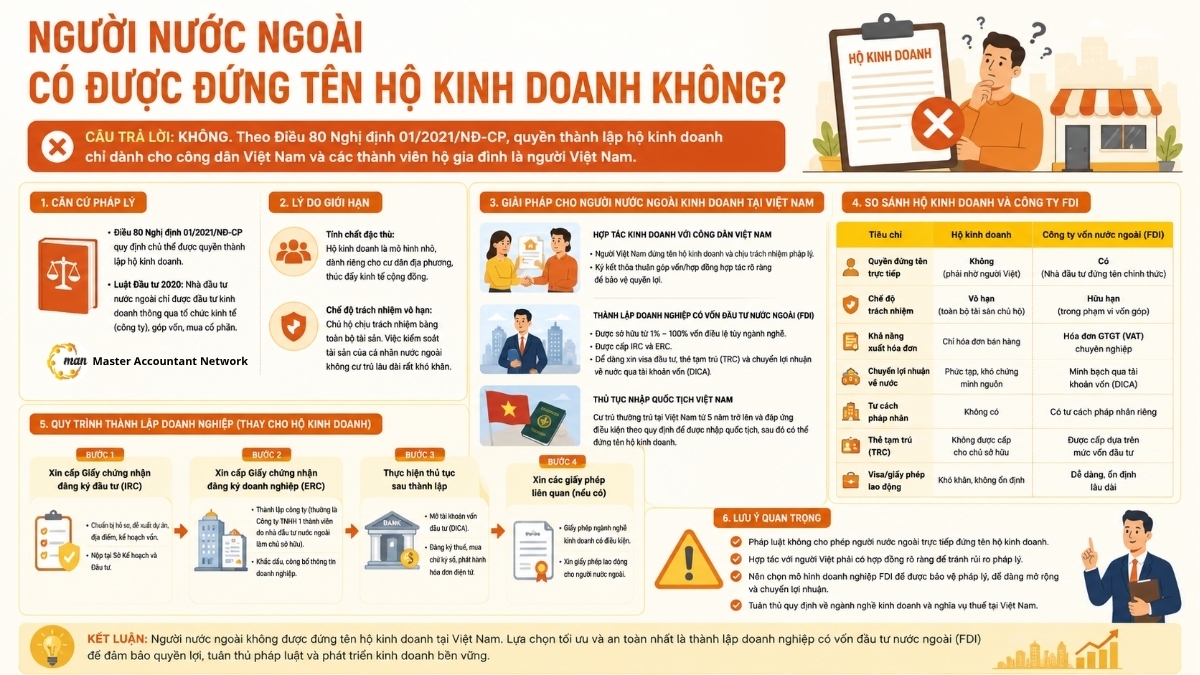
Based on Article 80 Decree 01/2021/ND-CP Regarding business registration, the list of entities entitled to establish a household business is clearly defined and includes:
- Individuals must be Vietnamese citizens aged 18 years or older.
- Household members (all must be Vietnamese citizens).
Besides, Investment Law 2020 The regulations also stipulate that foreign investors participating in the Vietnamese market must do so through forms such as establishing economic organizations (companies), foreigners contributing capital to Vietnamese companies, or purchasing shares, instead of the individual household business model. Therefore, foreigners registering as household businesses is not directly permitted by Vietnamese law at present.
The reason why the law restricts foreigners from being allowed to register a business in their name.
Restrictions on foreigners' right to open businesses in Vietnam stem from macroeconomic management reasons aimed at protecting the rights of domestic citizens:
- Specific characteristics: Household businesses are a model specifically designed for local residents, characterized by small-scale operations and streamlined management processes aimed at boosting the community economy.
- Unlimited liability regime: Business owners are liable for any debts incurred with their entire assets. Controlling the assets of non-resident foreign individuals poses a significant challenge for authorities in enforcing legal judgments or tax obligations.
Practical solutions for foreign individuals doing business in Vietnam.
While the answer to whether foreigners can register a business under their own name is clearly "no," investors can still operate businesses effectively through more suitable pathways.
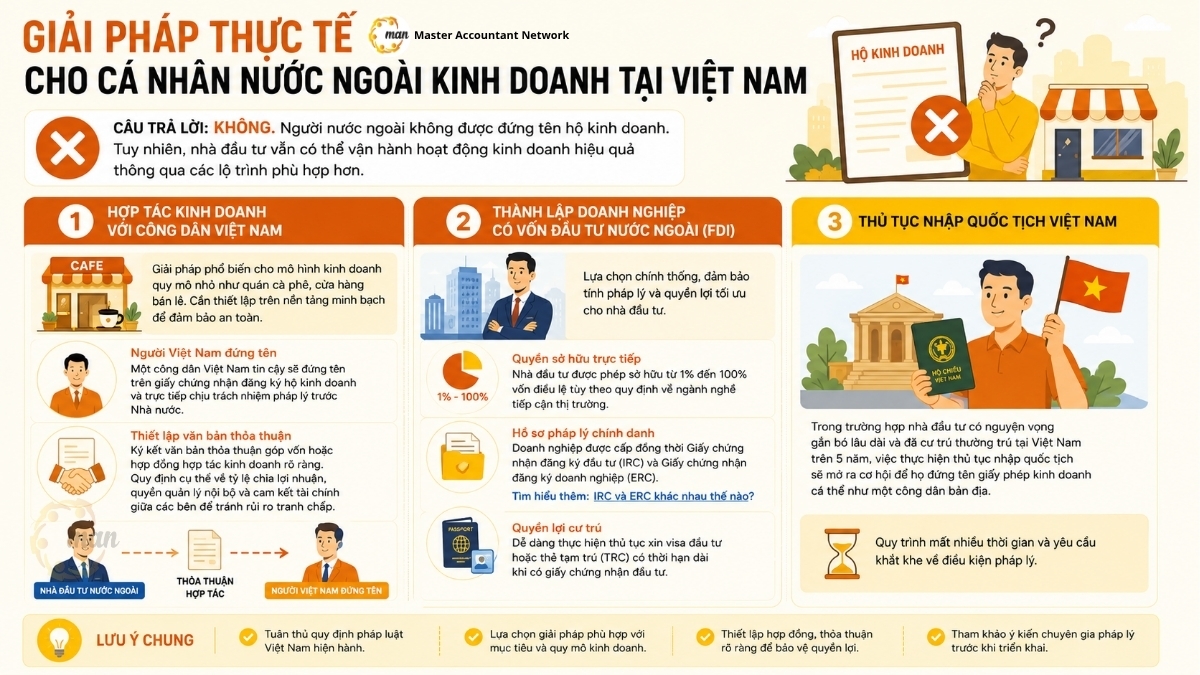
Business cooperation with Vietnamese citizens
This is a commonly adopted solution for small-scale business models such as cafes or retail stores. For this approach to be safe, it needs to be established on a transparent foundation:
- Vietnamese citizens are listed as owners: A trustworthy Vietnamese citizen will be named on the business registration certificate and will be directly legally responsible to the State.
- Establish the agreement document: To avoid the risk of disputes, the parties should sign a clear capital contribution agreement or business cooperation contract. This document will specify the profit-sharing ratio, internal management rights, and financial commitments between the parties.
Establishing a foreign direct investment (FDI) enterprise
Instead of worrying about whether foreigners can register a business under their name, many investors have chosen this model. complete business registration package To ensure legal compliance:
- Direct ownership: Investors are allowed to own between 11 TP3T and 1001 TP3T of charter capital, depending on the regulations regarding the industry and market access.
- Legitimate legal documents: Businesses will be issued both an Investment Registration Certificate (IRC) and an Enterprise Registration Certificate (ERC) simultaneously. You can find out more about this here. What is the difference between IRC and ERC? To understand the difference.
- Resident rights: Investors can easily apply for an investment visa or a long-term Temporary Resident Card (TRC) when they have the necessary documents. investment certificate.
Procedures for acquiring Vietnamese citizenship
In cases where investors wish to commit to a long-term stay and have been permanent residents in Vietnam for more than 5 years, the naturalization process will open up opportunities for them to register individual business licenses as native citizens. However, this is a time-consuming process with strict legal requirements.
Comparing foreigners opening companies or sole proprietorships.
To give investors a clearer picture of choosing the right business model, the comparison table below clarifies the most important aspects of management, operation, and resident rights.
| Criteria | Household business | Foreign direct investment (FDI) companies |
|---|---|---|
| The right to register ownership directly. | No (we need to ask a Vietnamese person) | Yes (The investor is officially listed) |
| Accountability system | Unlimited (all of the household's assets) | Limited (within the scope of contributed capital) |
| Invoice issuance capability | Sales invoice only | Professional VAT invoices |
| Repatriating profits | Complex, difficult to prove the source. | Transparency through DICA accounts |
| Legal personality | Do not have | It has its own legal personality. |
| Temporary Residence Permit (TRC) | Not issued to the owner | Granted based on the level of investment. |
| Work permit/Visa | Not supported | Assistance is provided in applying for work permit/investment visa exemption. |
Through this comparison, it can be seen that foreign individuals opening companies offer significantly better stability and legal protection compared to maintaining a sole proprietorship model through a third party.
Procedures for establishing a business instead of a household business for foreigners.
When investors realize that it is not feasible for foreigners to register a business under their own name, they should consider establishing a company instead. This process requires strict adherence to Vietnamese law.
Step 1: Apply for an Investment Registration Certificate (IRC)
Investors need to prepare documentation demonstrating their financial capacity and submit it to the investment registration authority (Department of Planning and Investment). The documentation includes a project proposal, business location, and a plan for the actual use of capital.
Step 2: Apply for an Enterprise Registration Certificate (ERC)
After obtaining the IRC, investors proceed with business registration. At this stage, information regarding the company name, business lines, and legal representative is officially recorded. During this phase, investors often collaborate with professional consulting networks such as MAN – Master Accountant Network to ensure the application is processed correctly.
Step 3: Complete tax obligations and investment capital account.
This is the post-establishment phase, encompassing the opening of a Direct Investment Capital Account (DICA), a payment account, and initial tax declarations. Adherence to Vietnamese accounting standards from the outset is crucial for the stable operation of the business. In fact, the law clearly prohibits foreigners from registering businesses under their own names; therefore, this step is extremely important for legalizing all operations.
Frequently Asked Questions about Foreigners Opening a Household Business
Below are answers to practical situations related to the question of whether foreigners can register business licenses in Vietnam under their own names.
Can foreigners be listed as business owners?
Can overseas Vietnamese open a business?
Can foreigners establish private businesses?
What type of company is the best alternative to a sole proprietorship for foreigners?
Conclude
In summary, the answer to the question of whether foreigners can register a household business under their name is "no," based on the regulations in Article 80 of Decree 01/2021/ND-CP. Instead, investors often choose the FDI business model to comply with legal regulations and ensure long-term benefits. Understanding these regulations helps you build a solid, legally compliant business foundation and minimize the risk of disputes in the Vietnamese market.
Contact information for MAN – Master Accountant Network
- Address: 19A, 43rd Street, Tan Thuan Ward, Ho Chi Minh City
- Mobile/Zalo: 0903 963 163 – 0903 428 622
- Email: man@man.net.vn
Content production is overseen by: Mr. Le Hoang Tuyen – Founder & CEO of MAN – Master Accountant Network, CPA Vietnam auditors with over 30 years of experience in accounting, auditing, and financial consulting.