





Businesses employing foreign workers often incur expenses such as salaries, allowances, housing, airfare, travel costs, or other benefits. To determine deductible expenses for foreign labor when calculating corporate income tax, businesses should not only check work permits. Expenses must also be substantiated, supported by appropriate documentation, and supported by payment receipts that meet tax regulations.
For FDI enterprises, simultaneously comparing labor records, accounting records, and payment documents is particularly important, especially when employees are transferred from abroad, move within the company, or are not required to obtain a work permit.
Under what conditions are foreign labor costs deductible?
In principle, foreign labor costs are deductible when the actual expenses are incurred, related to production and business activities, supported by valid invoices and documents, and meet the payment conditions as prescribed. The current tax basis is Decree 320/2025/ND-CP, amended and supplemented by Decree 141/2026/ND-CP.
Businesses can compare directly. Decree 320/2025/ND-CP on the Government's Electronic Information Portal when reviewing the conditions for deductible expenses.
General conditions for deductible expenses
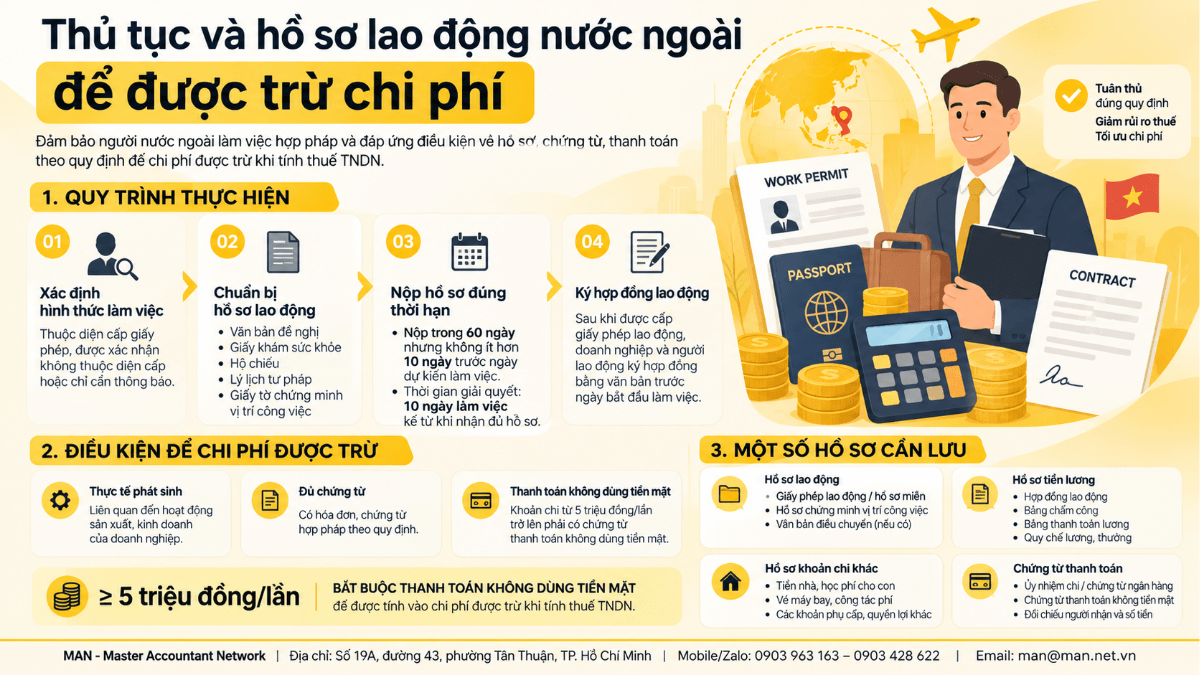
Before reviewing each type of document, businesses should examine the following three core groups of requirements:
- Actual expenses incurred and related to the business operations of the enterprise.
- There are sufficient legal invoices, receipts, or appropriate documents to prove the basis for the claim and the right to receive the money.
- There is a payment document that complies with regulations for expenses that are required to be paid using non-cash methods.
The important point is that a work permit is not the only condition for determining whether foreign labor costs are deductible. A work permit, a certificate confirming exemption from work permit requirements, or notification documents in each case can help prove employment status; however, the deductibility of the expense must be considered in accordance with tax laws and the actual documentation.
Conditions regarding salaries and wages for foreigners.
Regarding salaries and wages, businesses need to prove the type of work performed by the employee, the income received, the conditions for receiving it, the working hours, and the actual amount paid. If this information is consistent across the contract, time sheets, payroll records, and payment documents, the basis for proving deductible foreign labor costs will be clearer.
The following information should be cross-referenced throughout the file:
- Employment arrangements for foreigners in Vietnam.
- Salary, allowances, additional payments, and eligibility conditions for each payment.
- Actual working hours and basis for calculating salary.
- The actual amount paid by the business and the recipient of the money.
Salary payment from 5 million VND
From December 15, 2025, according to the Ministry of Finance's guidelines, salary and wage payments of 5 million VND or more must be supported by non-cash payment documents to qualify as deductible expenses. This threshold is determined based on the value of each payment, not just the employee's total monthly income.
Businesses can check how to apply at Ministry of Finance guidelines on salary and wage payments.
Therefore, when reviewing deductible foreign labor costs, businesses should keep separate payment documents corresponding to each payment, especially for experts, managers, and high-paid personnel.
Documentation proving that foreign labor costs are deductible.
A good set of documents isn't necessarily the one with the most paperwork, but rather one that can explain the entire chain from the basis for employing the worker to the actual amount the business spent. Since foreign labor costs are deductible, the documentation should be organized by individual worker and by type of expense.
Work permit or other documents not subject to issuance
Decree 219/2025/ND-CP stipulates various forms of foreign employment in Vietnam and cases that do not require a work permit. Therefore, businesses need to correctly determine the legal status of their employees before completing the necessary paperwork.
Businesses can refer to this. Application for a work permit for a foreigner Contact MAN for verification of required documents. Depending on the case, the application should clearly demonstrate one of the following:
- Work permits remain valid in cases where they are required to be issued.
- A certificate confirming that the applicant is not subject to the work permit requirement if the law requires such a procedure.
- Documentation proving that a confirmation letter is not required but notification must be made as per regulations.
Contracts and documents determining benefit levels
Employment contracts, agreements, appointment decisions, transfer documents, or similar documents must clearly demonstrate the basis for the company's payment. Allowances, benefits, or additional payments should have clearly defined eligibility conditions and amounts for comparison with the payroll.
If employees are transferred from a parent company or foreign enterprise, the company needs to keep records of the assignment or transfer and related documents concerning the form of employment. The entire expenditure should not be explained solely based on the internal payroll records of the Vietnamese enterprise.
Time sheets, payrolls, and payment vouchers
The sequence of documents should be checked as follows:
- Contract or agreement → working hours → time sheet.
- Time sheet → payroll → payment decision or basis, if any.
- Payroll → payment voucher → verify recipient.
If one link in the chain has information that differs from the rest, the business may have to provide further explanation. This is often overlooked when assessing deductible foreign labor costs, because the expense may have actually been incurred but the documentation does not fully prove the basis and payment process.
Procedures for completing the paperwork for foreign workers.
To reduce the risk of including expenses in tax filings, businesses should process labor records before or simultaneously with establishing payroll records. According to Decree 219/2025/ND-CP, the current procedure should be determined according to the specific work arrangement of each individual.
Businesses can refer to the guidelines. Issuing work permits for foreigners in Vietnam. of MAN when preparing the actual documents.
| Step | Things that need to be done | Points to check |
| 1. Determine the type of work. | Identify employees who have signed contracts in Vietnam, are internally transferred, are transferred from abroad, or are exempt from certain regulations. | A checklist cannot be applied to every situation. |
| 2. Determine the license status. | Determine whether a permit is required, confirmation of exemption is needed, or only notification is required. | Based on the specific conditions of each case. |
| 3. Prepare the documents. | Prepare Form No. 03 and other documents regarding health, passport, criminal record, and the position and type of work as required. | Check foreign documents, translate and legalize them when necessary. |
| 4. Submit and receive results | For permit applications, employers must submit their applications within the legally mandated timeframe before the scheduled start date. | Monitor processing deadlines and request additional information if necessary. |
| 5. Complete the personnel file. | After obtaining the necessary permits (if required), sign a written employment contract before the start date of work. | The information must be consistent with payroll records. |
| 6. Establish accounting records | Prepare time sheets, payrolls, payment decisions, and payment vouchers. | Check the 5 million VND threshold for each payment. |
According to Decree 219/2025/ND-CP, applications for work permits must be submitted within 60 days and no less than 10 days before the expected start date; the competent authority will process the application within 10 working days from the date of receipt of a complete and valid application. After the work permit is granted, for cases involving employment under a labor contract, the enterprise and the employee must sign a written contract before the expected start date.
To compare with the original regulations, businesses can view them. Decree 219/2025/ND-CP on the Government's Electronic Information Portal.
Documents required for each case of a foreigner working in Vietnam.
The documentation process can vary depending on the type of employment. Therefore, when verifying deductible foreign labor costs, FDI enterprises should first determine the legal basis before comparing the supporting documents.
Foreigners sign labor contracts with Vietnamese businesses.
In this case, the business needs to ensure that labor records, contracts, time sheets, payrolls, and payment documents form a unified chain. If a work permit is required, the permit must be processed according to current regulations.
Businesses can further compare the article. Issuing work permits for foreigners in Vietnam MAN will check the practice points in the record.
Foreigners moving within the company.
Internal transfers within a company should be distinguished from signing a direct employment contract with a Vietnamese company. The documentation should demonstrate the relationship between the companies, the transfer decision or document, the job position, and the period of employment in Vietnam.
From a tax perspective, businesses still need to prove that the expenses incurred are actually related to business operations and that there is sufficient evidence and documentation as required by regulations. The fact that the parent company abroad pays a portion of the income does not automatically mean that the entire amount becomes an expense of the Vietnamese business.
Foreigners who are not required to obtain a work permit.
The absence of a work permit does not automatically mean that wages will be withheld. The important thing is that the business must provide valid evidence proving that a work permit is not required and follow the corresponding procedures. Some cases require a confirmation document, while others only require notification as per regulations.
Businesses can refer to this article. How to obtain a work permit for foreigners To compare the case classification method before preparing the application.
Foreign nationals sent to Vietnam by foreign businesses.
For personnel sent or transferred to Vietnam by foreign companies, the documentation must clearly state the sending entity, the time period, the position, and the basis for determining the actual expenses incurred by the Vietnamese company. If salaries or expenses are allocated among multiple companies, documentation explaining the allocation basis and payment responsibilities is required.
Other expenses for foreign workers
In addition to salaries, businesses may provide housing allowances, children's tuition, airfare, travel expenses, or other benefits. These expenses should not be grouped together under a single principle; the nature of the expense, eligibility conditions, and corresponding documentation should be examined.
| Expenditure | Key Profiles | Points to check |
| Salaries, wages | Contracts/agreements, timekeeping records, payroll, payment vouchers. | Eligibility requirements, actual amount, and payment terms start from 5 million VND. |
| Rent | Employment contract or basis of agreement, lease agreement, invoice/document. | Expenditures must comply with regulations and be fully documented. |
| Tuition fees for children | Employment contract, terms and conditions, invoices/receipts from the educational institution. | Compare with current regulations regarding expenses for foreign workers. |
| Flight tickets, travel | Ticket documents, purpose of travel, business trip documents, or proof of entitlement. | Distinguish between expenses incurred for work-related purposes and personal benefits. |
| Other allowances and benefits | Contracts, agreements, regulations, payment decisions, and documentation. | The eligibility criteria and benefit levels must be clearly substantiated. |
Rent and housing expenses
Regarding housing allowances paid by businesses to foreign workers, it is necessary to verify the basis of the agreement and supporting documents for the expenditure. Decree 320/2025/ND-CP has specific regulations for housing allowances for employees if they meet the conditions regarding documentation and the nature of salary/wage.
Tuition fees for children of foreign workers
Current regulations already include provisions regarding tuition fees for the children of foreign workers aged from preschool to high school, provided that the expense is stipulated in the employment contract and is supported by complete invoices and documentation as required.
Therefore, when considering the deductibility of foreign labor costs for tuition fees, businesses should prioritize comparing current regulations rather than relying solely on Circular 91784/CT-TTHT of 2019.
Airfare, travel expenses, and allowances.
Airline tickets and travel expenses should be categorized by purpose. If for business purposes, the documentation should clearly state the purpose of the trip and include relevant supporting documents. If for personal benefit, the company needs to check the applicable conditions.
Regarding allowances and other benefits, businesses should ensure that the eligibility conditions, benefit levels, and payment basis are stipulated beforehand or simultaneously in the appropriate documentation. Expenses incurred outside of the agreed-upon terms without clear justification increase the risk during the accountability process.
Cases that are easily excluded from deductible expenses.
The risk often lies not in the foreign nationality of the worker, but in the gaps between labor records, accounting records, and payment documents. Several situations require verification before concluding that foreign labor costs are deductible, including:
- There are only payroll records, but no documents proving the type of employment or legal status of the workers.
- The contract states the basic salary, but the payroll includes allowances or additional payments without any justification regarding the conditions and amount of entitlement.
- The working hours recorded in the employee's file do not match the time sheets or the time allocated for expenses.
- The name of the recipient, the amount, or the payment date do not match the payroll records and personnel files.
- Individual salary payments of 5 million VND or more, but without non-cash payment documentation.
- Expenses paid by foreign businesses or individuals, but Vietnamese businesses lack the basis to prove responsibility or record the expenses.
A practical example of deductible foreign labor costs.
In the case of signing a direct employment contract.
A foreign direct investment (FDI) enterprise signs an employment contract with a foreign expert. The employment records are in order, the contract clearly defines the salary and benefits, and the enterprise maintains attendance records, payrolls, and payment documents. If the tax conditions are met, the salary amount can be considered a deductible foreign labor expense.
In the case of transfers from the parent company overseas...
A foreign parent company transfers personnel to a foreign-invested enterprise (FDI) in Vietnam. The Vietnamese enterprise needs documentation proving the nature of the transfer, the duration of employment, the position, and the actual expenses incurred by the Vietnamese enterprise. Tax records should not rely solely on payroll records without documentation of the transfer relationship.
In the case of payment of 20 million VND each time
A company pays a foreign expert 20 million VND in salary in a single payment. Since each payment is 5 million VND or more, the company needs non-cash payment documentation to meet the conditions for deductible foreign labor expenses. If only a payroll sheet is available without proper payment documentation, the expense may become risky during the tax settlement process.
The documentation should be completed before final settlement.
Instead of waiting until the tax settlement period to gather documents, FDI enterprises should complete the records for each employee in the period in which the expense arises. The following checklist can be used to review deductible foreign labor expenses:
- Documents specifying the type of work and work permit status, or corresponding exemption documents.
- Employment contract, agreement, appointment decision, or transfer document.
- Salary and bonus regulations or documentation serving as the basis for any additional payments.
- Time sheets, payroll records, and payment decisions.
- Receipts and invoices for rent, tuition fees, airfare, or other expenses, if any.
- Payment vouchers, especially for salary payments of 5 million VND or more.
- The documentation explains the responsibility for payment or allocation of costs when a parent company or foreign enterprise is involved in the payment.
Legal basis for deductible foreign labor costs.
When dealing with deductible foreign labor costs, businesses should compare both corporate income tax regulations and regulations concerning foreign workers. The key documents include:
- Decree 320/2025/ND-CP: stipulates the conditions for deductible and non-deductible expenses when determining corporate income tax.
- Decree 141/2026/ND-CP: amending and supplementing some provisions of Decree 320/2025/ND-CP.
- Decree 219/2025/ND-CP: regulates foreign workers working in Vietnam, forms of employment, work permits, and cases where work permits are not required.
- Circular 20/2026/TT-BTC: provides detailed regulations on some contents of the Corporate Income Tax Law and Decree 320/2025/ND-CP.
Official legal sources that can be consulted directly: Decree 141/2026/ND-CP and Circular 20/2026/TT-BTC.
Conclude
To determine the deductible foreign labor costs for corporate income tax purposes, businesses need to examine three layers of documentation simultaneously: labor records, accounting records, and payment vouchers. A work permit is only one part of the documentation and does not replace the conditions regarding expenses as stipulated by tax laws.
Specifically, from December 15, 2025, businesses need to control the value of each salary and wage payment to ensure non-cash payment documentation for amounts of 5 million VND or more. For FDI businesses with personnel transferred from abroad, correctly identifying the form of work and payment responsibility from the outset will help ensure more consistent deduction of foreign labor costs during tax settlement.
If the records involve multiple layers of relationships between the Vietnamese company, the parent company, and the employee, the business should review them before making payments and accounting entries, instead of waiting until the final settlement period to supplement the documents.
Professional license: CPA Vietnam Auditors
Experience: Over 30 years of experience in Accounting, Auditing, and Financial Consulting.
Frequently Asked Questions about Deductible Foreign Labor Costs
Are foreigners without work permits eligible for fees?
Possibly. The absence of a work permit does not automatically disallow the expense if the employee is exempt from work permit requirements and the business has sufficient documentation to prove this, while also meeting the tax conditions for the expense.
Are salaries of 5 million VND or more subject to non-cash payment methods?
Yes, if this is a one-time salary or wage payment of 5 million VND or more, it falls within the applicable scope. Businesses need to retain the corresponding non-cash payment documents to meet the conditions for deductible expenses.
Are tuition fees for the children of foreign workers deductible?
It may be considered if the conditions of current regulations are met, paying particular attention to cases where tuition fees for the children of foreign workers are stipulated in the labor contract and supported by complete invoices and documents. Businesses should check current regulations at the time of settlement instead of relying solely on outdated guidelines.